
Cheongdam Botox | Differences Between Botox and Skin Botox, Injection Methods, and Considerations
2026-10-30
Contents
Are Botox and Skin Botox the Same Procedure?
Botox and Skin Botox both utilize botulinum toxin, but the injection depth and the skin concerns being addressed determine the different treatment methods.
Traditional Botox is primarily used to reduce wrinkles by controlling the movement of facial muscles. In contrast, Skin Botox involves injecting small amounts of botulinum toxin into the superficial layers of the skin, managing fine lines, skin texture, and sebum production to improve the skin's surface.
For instance, if you are concerned about the wrinkles that form when frowning, and the appearance of enlarged pores or rough skin texture on the cheeks, the issues being addressed are different. The former focuses on controlling muscle movement, while the latter can focus on improving the condition of the skin's surface.
Even when using the same botulinum toxin, the expected changes can vary based on the injection location, depth, and scope of application.
What Wrinkles Does Botox Effectively Treat?
Traditional Botox temporarily weakens muscle contractions to alleviate wrinkles that occur when making facial expressions.
When we express ourselves, various facial muscles contract, causing the skin to move as well. Botulinum toxin works by blocking the nerve signals sent to the muscles, reducing excessive contractions.
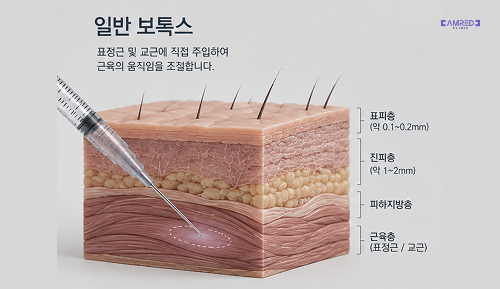
Commonly treated areas include the glabella, forehead, and around the eyes. Vertical wrinkles that form when frowning or horizontal wrinkles that appear when raising the forehead, as well as wrinkles around the eyes when smiling, are closely related to the movement of facial muscles.
Applying Botox to these areas can reduce the degree to which the skin folds when making facial expressions.
However, wrinkles that are already deeply set and remain even when not making expressions may not improve sufficiently by merely reducing muscle movement. This is because structural changes caused by decreased skin elasticity or repetitive movements can also have an impact.
Additionally, since facial muscles are interconnected, the injection location and dosage can affect the height of the eyebrows and the overall expression. It is essential to consider both muscle movement and facial balance to maintain a natural expression while alleviating wrinkles.
What Skin Concerns Can Skin Botox Address?
Skin Botox is a procedure that involves injecting small amounts of botulinum toxin into the relatively superficial layers of the skin. While traditional Botox focuses on controlling the movement of specific muscles, Skin Botox is used to manage detailed changes that appear on the skin's surface.
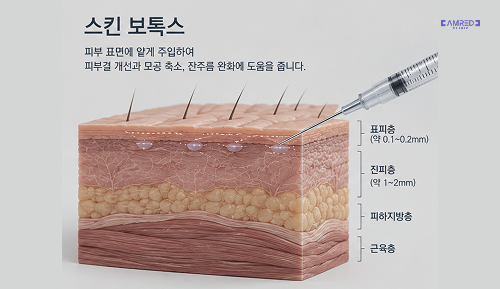
It is particularly considered for concerns such as fine lines, sebum production, and enlarged pores.
Areas around the nose or cheeks with high sebum production may show more prominent pores. The method of injecting botulinum toxin into the superficial layers of the skin can influence sebum production, helping to improve the appearance of pores.
It is also used for fine lines that appear on the skin's surface and changes in skin texture. However, Skin Botox does not eliminate all fine lines or permanently reduce enlarged pores. Other treatments may be necessary if pores are prominent due to decreased skin elasticity or acne scars.
Since Skin Botox is injected at multiple points on the face, the depth, dosage, and muscle movement in each area must be considered. Even when injected into the superficial layers of the skin, it can still affect surrounding muscles, necessitating precise adjustments based on the treatment area.
Are There Cases Where Botox and Skin Botox Are Administered Together?
Botox and Skin Botox have different improvement goals, so it is possible to consider applying them together depending on the skin condition.
For example, if you are concerned about expression lines that form when frowning and the appearance of pores and skin texture around the cheeks simultaneously. In this case, traditional Botox can be applied to the glabella to control muscle contraction, while Skin Botox can be considered separately for managing changes in the skin's surface on the cheeks.
On the other hand, if you are concerned about fine lines and skin texture on the forehead, the areas of application may be closer together. In this case, rather than simply adding the two methods, the injection location and dosage should be determined by considering the movement of the forehead muscles, the depth of the wrinkles, and the thickness of the skin.
Especially since various facial muscles influence each other during the process of making expressions, excessive muscle inhibition can lead to unnatural expressions or asymmetry.
Therefore, the two procedures are not interchangeable but can be selected or combined based on the improvement goals. When considering changes in expression lines and skin condition together, the roles of each treatment can be applied distinctly.
What Reactions Can Occur After Botox and Skin Botox Treatments?
Both Botox and Skin Botox involve injecting botulinum toxin, and temporary redness, bruising, swelling, and tenderness may occur after the procedure. These reactions generally subside over time, but the degree of occurrence and recovery speed can vary based on individual skin conditions, treatment areas, and injection methods.
Traditional Botox controls the movement of facial muscles, so changes in expression may occur after the procedure depending on the injection location and dosage. Particularly in the forehead, glabella, and around the eyes, reactions such as changes in the position of the eyebrows or eyelids, or asymmetry in expressions may occur due to the influence on surrounding muscles.
In contrast, while Skin Botox involves injecting small amounts into the superficial layers of the skin, the possibility of affecting surrounding muscles is not entirely eliminated. Especially around the mouth or cheeks, where multiple muscles move together when smiling or speaking, temporary awkwardness in expressions or discomfort in muscle movement may arise depending on the injection location and dosage.
Both procedures have individual variations in the onset of effects and duration. Even when using the same product, the perceived changes can differ based on muscle movement, skin condition, injection areas, and dosage, and the effects of botulinum toxin gradually diminish over time.
Most post-treatment reactions are temporary, but if unexpected muscle weakness or changes in expression persist, medical attention may be necessary. In rare cases, if difficulties in swallowing or breathing occur, immediate evaluation and treatment at a medical facility are required.
How Does AMRED Differentiate Between Botox and Skin Botox Treatments?
AMRED distinguishes the causes of wrinkles and the condition of the skin to plan the injection sites and methods.
For example, if the wrinkles on the glabella deepen when making expressions, the movement of the muscles around the eyebrows and glabella is examined to determine the injection location and dosage for traditional Botox. The aim is to alleviate wrinkles while maintaining the position of the eyebrows and a natural expression by considering the action of surrounding muscles.

Conversely, if concerns involve enlarged pores, skin texture, or fine lines on the cheeks, the thickness of the skin, sebum production, and elasticity are examined to evaluate the application and scope of Skin Botox.
The criteria for examining these differences is AMRED's 4D Aging Resolution. It considers detailed changes such as wrinkle depth and skin texture (DETAIL), the density of skin and tissues (DENSITY), the overall balance and expression of the face (DESIGN), and changes over time and durability (DURABILITY).
Based on this, areas requiring treatment for facial muscles and areas needing improvement in skin condition are distinguished, allowing for either a single treatment or a combination of both methods based on individual conditions.
Even though both procedures use the same botulinum toxin, controlling muscle movement and managing changes in the skin's surface are different goals. AMRED differentiates the roles of each based on the causes of wrinkles and skin conditions, considering natural expressions and overall facial balance during treatment.
4D is a proprietary aging analysis and treatment design perspective defined by AMRED and does not refer to an independent medical diagnostic classification or a single treatment name.
Actual treatment plans may vary based on the medical staff's assessment and individual conditions.