
Cheongdam Dermatology | What to Check Beyond the Differences in Domestic and Imported Botox Prices?
2026-10-30
Contents
What are the differences between domestic and imported Botox?
When considering Botox treatment, you may wonder which to choose between domestic and imported products. Even for treatments applied to the same area, prices can vary by product, and you may be curious about differences in effectiveness and duration.
Domestic and imported Botox are categorized based on the country of manufacture and product brand. Both product groups work on the principle of temporarily controlling muscle movement using botulinum toxin.
For example, the wrinkles that appear when frowning are created by the contraction of the muscles in that area. Botox is used to alleviate these muscle movements to improve expression lines. In cases where muscle development affects facial contours, such as a square jaw, botulinum toxin treatment can also be considered.
However, domestic and imported products differ in manufacturing processes, formulations, and clinical trial data depending on the manufacturer. The treatment plan may vary based on the characteristics of the product, the actual injection site, and the dosage.
The distinction between domestic and imported serves as a reference when selecting a product, but the actual effectiveness should be considered alongside the specific characteristics of each product and the treatment method.
Do different Botox products have different characteristics?
There are several manufacturers of Botox used in Korea. Domestic products include Nabota, Botulax, and Coretox, while imported products are represented by Allergan Botox and Xeomin.

All these products are used to control muscle movement, but there are differences in the manufacturing process, purification methods, and the components that make up the products.
For example, the method of purifying botulinum toxin and the composition of proteins or additives included can vary by product. These characteristics are factors examined in studies regarding product stability and immune responses.
Each product secures data on effectiveness and safety through clinical trials. In fact, a clinical trial comparing the wrinkle improvement effects of domestic Nabota and imported Botox found that Nabota's effectiveness was not inferior to that of the comparison products.
This provides evidence that clinically confirmed wrinkle improvement effects can be expected even from domestic products. However, the results of studies comparing specific two products cannot be generalized to imply that all domestic and imported Botox have the same effectiveness.
Additionally, the criteria for the dosage used may differ by product. The units for indicating Botox dosage are determined according to the characteristics of each product, so different products should not be simply compared using the same numbers or arbitrarily applied.
In treatment, the dosage and injection methods suitable for each product's characteristics are used, and the application range is determined considering the actual area to be improved and the condition of the muscles.
Why do prices differ between domestic and imported Botox?
The supply prices and distribution structures of domestic and imported Botox vary by product, and costs can also differ based on the treatment composition of medical institutions.
Imported products may reflect the supply and domestic distribution processes of overseas manufacturers, and domestic products also have varying supply prices depending on the manufacturer and product type. Therefore, it is difficult to simply understand price differences as quality differences based on the country of manufacture.
Moreover, even for the same Botox treatment, actual costs can vary depending on the application area and usage amount.
For example, the treatment to alleviate expression lines on the forehead differs in required dosage and injection sites from the treatment to reduce the movement of developed jaw muscles. When treating both the forehead and frown lines together, the plan may differ from treating just one area.
Some medical institutions may structure treatments for specific areas as a single program or set costs based on the products and dosages used. Therefore, even when using the same domestic or imported product, the actual treatment costs may vary.
The price of Botox reflects not only the products used but also the treatment area, required dosage, and the program structure of the medical institution. The actual improvement effect is not solely determined by these cost differences.
Are there differences in duration and tolerance between domestic and imported Botox?
Botox shows its effect in suppressing muscle movement after a certain period following injection. For treatments aimed at expression lines, changes are typically felt within a few days, and the effects may become more pronounced over about 1 to 2 weeks.
The duration is generally indicated as approximately 3 to 4 months for expression line treatments, but the actual duration can vary based on the treatment area, muscle development, product used, dosage, and individual responses.
For example, the treatment to reduce the movement of expression muscles like the forehead or frown lines differs in the timing of effect perception and evaluation criteria from treatments expecting volume changes in developed muscles like a square jaw.
When receiving Botox repeatedly, concerns about tolerance may arise. If neutralizing antibodies against botulinum toxin are formed, the response to the drug may decrease, but the actual occurrence of antibody formation is relatively rare.
Furthermore, just because the effect feels weaker than previous treatments does not necessarily mean tolerance has developed. Changes in muscle condition, injection volume, application site, and treatment intervals can also lead to differences in perceived effects.
The manufacturing methods and component compositions of each product are factors considered when researching immune responses, but the distinction between domestic and imported cannot predict the likelihood of tolerance occurrence.
In repeated Botox treatments, the previous product used, dosage, treatment intervals, and the duration of effect should all be considered when planning the next treatment.
What should be noted regarding products and injection methods during Botox treatment?
Botox is an injection treatment that can be performed relatively quickly, but since it is a drug that controls muscle movement, caution is needed regarding the application area and dosage.
Immediately after treatment, redness, bruising, swelling, and tenderness may occur at the injection site, and these reactions are mostly temporary. The recovery speed and severity of symptoms can vary depending on individual skin conditions and the injection site.
In areas where multiple expression muscles are close together, such as the forehead, frown lines, and around the eyes, unintended muscles may also be affected, which can change the position of the eyebrows or eyelids or make expressions appear asymmetrical.
In square jaw treatments, not only the size and development of the jaw muscles but also the chewing function and movements of surrounding muscles must be considered. Depending on the injection site and dosage, chewing strength may temporarily weaken, or unexpected changes in facial contours may occur.
Proper management of the product itself is also important. Botulinum toxin is a pharmaceutical product that must be managed according to the storage and preparation standards of each product, and approved genuine products must be used under appropriate conditions.
Additionally, if there have been uncomfortable reactions after previous Botox treatments or if there are related health conditions such as neuromuscular diseases or medications being taken, these should be reflected in the process of determining treatment suitability.
Rarely, the action of botulinum toxin may spread more widely than expected, leading to difficulties in swallowing or breathing, and such symptoms require immediate medical evaluation and treatment.
How does AMRED choose between domestic and imported Botox?
Domestic and imported Botox have different characteristics depending on the manufacturer and product, but it is difficult to determine that a specific product is superior in all treatments based solely on the country of manufacture. AMRED reviews botulinum toxins suitable for treatment purposes based on the characteristics of individual products and clinical evidence.
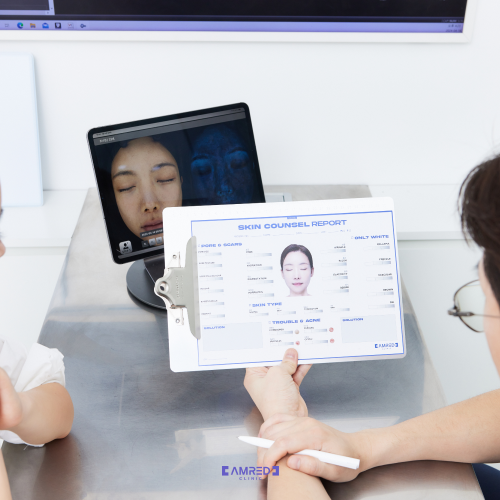
When selecting a product, the approved usage range, clinical data, and injection dosage of the formulation are considered. Even for the same wrinkle improvement purpose, the usage criteria may differ by product, and these differences are reflected in the actual treatment plan.
If you have previous experience with Botox treatments, you can also consider the product used, its effectiveness, duration, and post-treatment responses.
For example, if the effect of the previous product felt shorter than expected, simply switching to a product from a different country may not be the solution. It is important to review the dosage and area injected, treatment intervals, and individual responses to determine if a product change is necessary.
AMRED's 4D aging resolution is not a standard for distinguishing the superiority of Botox products but rather a perspective that examines individual wrinkles, muscle movements, and facial balance to clarify treatment objectives. Based on this, the necessary treatment areas and ranges are determined, and suitable products and dosages are considered.
In choosing between domestic and imported Botox, what is important is not just the price or country of manufacture but also the characteristics of individual products, clinical evidence, previous treatment experiences, and actual treatment objectives.
AMRED plans botulinum toxin treatments suitable for individual conditions based on these criteria.
4D is a self-defined aging analysis and treatment design perspective by AMRED and does not refer to an independent medical diagnostic classification or a single treatment name.
Actual treatment plans may vary based on the medical staff's examination and individual conditions.