
Cheongdam Dermatology | Is Juveàcell Less Painful Than Re2O? Differences in Formulation and Treatment Method
2026-10-30
Contents
Is Juveàcell Less Painful Than Re2O?
When considering skin booster treatments, the pain experienced during the procedure is as important as the expected effects. Juveàcell and Re2O are often compared products aimed at improving skin elasticity and density.
Both products are based on acellular dermis (hADM) derived from human dermal tissue, with a common purpose of supplementing the extracellular matrix (ECM) composed of collagen and elastin.
However, being in the same ECM category does not mean that the formulations and treatment methods are identical.
Juveàcell (Juveàcell) is provided in a pre-hydrated syringe form, while Re2O is used in a powdered form that is mixed before treatment. This difference in formulation can affect the needles and injection pressure used during the actual injection process.
Notably, Juveàcell is designed to allow for relatively gentle injections. However, this characteristic does not mean that it will always be less painful than Re2O. Actual pain levels can vary based on the product's formulation, injection method, application area, and individual sensitivity.
What Are the Differences in Ingredients and Formulation Between Juveàcell and Re2O?
Both Juveàcell and Re2O are ECM products that use human-derived acellular dermis. The differences arise in the processing methods of the raw materials, final formulations, and product compositions.
Juveàcell utilizes supercritical carbon dioxide (CO₂) to remove cellular components during processing. This process aims to preserve structural components of skin tissue, such as collagen and elastin, while removing cellular components.
The product is available in two concentrations, 3% and 8%, each differing in the content of acellular dermis. Both products are provided in pre-filled syringe forms, allowing for use without a separate mixing process.
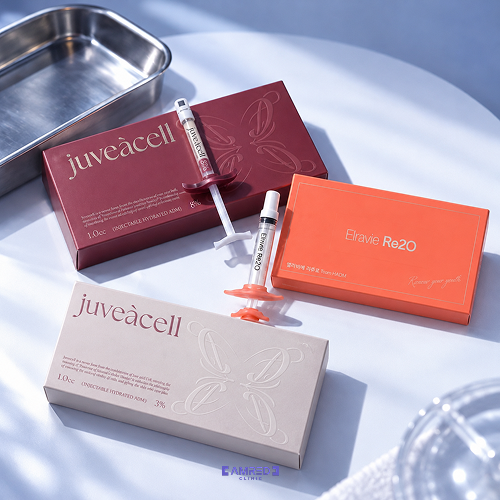
In contrast, Re2O is a product processed into a fine powder form of acellular dermis. The basic product is provided in 150mg units and is prepared for injection by hydrating the powder before use.
Therefore, the 3% and 8% labels of Juveàcell cannot be directly compared to the 150mg label of Re2O on the same basis. One indicates the content in the final formulation, while the other indicates the amount of raw material contained in the product.
Both products share the common goal of supplementing ECM, but the differences in formulation and composition can lead to variations in the actual preparation process and injection conditions.
What Factors Affect Pain During ECM Skin Booster Treatments?
ECM skin boosters involve injecting ingredients into the skin using a needle. Therefore, discomfort can arise not only from the moment the needle penetrates the skin but also from the pressure or pain experienced as the ingredients enter the skin tissue.
Factors such as the viscosity and particle characteristics of the injected formulation, as well as the injection pressure, can influence the discomfort felt during the procedure.
Juveàcell is designed to reduce resistance during injection due to its liquid formulation. According to manufacturer data, Juveàcell 3% allows for the use of fine needles based on its homogeneous particle characteristics, enabling treatment at relatively low injection pressures.
However, even within Juveàcell, the 3% and 8% formulations differ in concentration, leading to variations in the recommended needle specifications. Therefore, it is not possible to describe all treatment conditions or pain levels solely based on the name Juveàcell.
Re2O involves injecting a hydrated formulation, and the actual mixing conditions, needle used, and injection method can lead to variations in the sensations experienced during the procedure.
Additionally, when injecting multiple points across the entire face versus focusing on specific areas, the number of injections and the amount injected can differ. Pain levels may also vary in areas with different skin thicknesses, such as around the eyes or cheeks.
Methods for managing pain, such as topical anesthesia and controlling injection speed, also affect the actual experience. In other words, while Juveàcell's formulation is designed to reduce discomfort during injection, it is essential to consider both the product characteristics and the actual treatment conditions when assessing pain differences between the two products.
What Skin Concerns Can Juveàcell and Re2O Address?
Based on their common characteristic of supplementing the extracellular matrix, Juveàcell and Re2O are utilized for various skin concerns, including skin texture, elasticity, and fine lines.
The dermis layer of the skin contains components such as collagen and elastin that support the elasticity and structure of the tissue. As aging progresses, changes in these structural components can lead to decreased skin elasticity and more pronounced fine lines.
ECM treatments are used to help improve skin condition by supplementing these components of skin tissue.
For example, if the skin around the cheeks becomes thinner and loses elasticity, leading to rough skin texture, ECM treatments can be considered based on the skin's thickness and condition.
Juveàcell is available in 3% and 8% formulations, allowing for differentiation based on the application area and skin condition. Re2O also has product variations, including the basic product and Re2O Fine, which is processed into finer particles.
However, even within the same product line, injection conditions and areas of consideration can differ based on the formulation, so one cannot simply expect better results based solely on higher concentrations or smaller particles.
Additionally, deeply etched wrinkles or significant volume loss, as well as sagging of the entire face, may not be sufficiently improved by merely supplementing the skin's ECM components.
When selecting between the two products, factors such as skin thickness, degree of elasticity loss, depth of fine lines, and the specific areas to be treated are all considered.
What Reactions Can Occur After Juveàcell and Re2O Treatments?
Both Juveàcell and Re2O are used through injection into the skin, so temporary redness, swelling, bruising, and tenderness may occur after treatment.
Immediately after treatment, the injection site may appear temporarily swollen, or there may be a sensation of tightness in the skin. These reactions can vary based on the amount injected, depth, area, and individual skin condition.
Particularly in thinner areas of skin, there is a possibility that the injected ingredients may not disperse evenly or that some areas may experience lumping. Therefore, it is necessary to carefully adjust the particle characteristics of the product, injection depth, and the amount applied to one area.
Moreover, since human-derived tissue components are used, the management of raw materials, processing, sterilization, and storage conditions are also critical safety factors. While Juveàcell and Re2O differ in manufacturing processes, both products require appropriate tissue management and a safe treatment environment.
There is also individual variability in the recovery process. Even when using the same product, the duration of swelling and discomfort can differ based on skin thickness, treatment area, and injection method.
If redness and swelling worsen after treatment, or if there is a sensation of heat, persistent pain, or unexpected lumps, it is essential to consult medical professionals to determine the cause.
How Does AMRED Apply Juveàcell and Re2O?
AMRED considers the thickness, density, and degree of elasticity loss of the skin when planning ECM treatments, along with the formulation and application areas of the products.
For instance, when managing the elasticity and texture of cheek skin, it is important to assess the skin condition and the required application range to determine if supplementing ECM components is appropriate.
Conversely, in areas like around the eyes where the skin is thin and fine lines are pronounced, it is crucial to consider skin thickness, injection depth, and the particle characteristics of the product more meticulously. Treatment conditions may vary based on the products and formulations used in these areas.

While Juveàcell and Re2O are both ECM products, their differences in formulation and injection methods necessitate distinct treatment plans tailored to the application areas and skin conditions. If a patient is sensitive to pain, considerations for injection characteristics, anesthesia methods, injection amounts, and treatment ranges can be made to manage discomfort.
AMRED's 4D Aging Resolution serves as a guideline for designing treatments that address these skin changes. It considers the density and elasticity of skin tissue (DENSITY), detailed changes such as fine lines and skin texture (DETAIL), overall facial balance (DESIGN), and changes and durability after treatment (DURABILITY).
Based on this, areas needing ECM component supplementation and the expected improvement goals are identified, and the product characteristics and treatment methods are considered to establish the application range and injection plan.
The differences between Juveàcell and Re2O are not only in pain intensity but also in formulation, processing methods, and injection conditions. AMRED plans suitable ECM treatments by examining these characteristics alongside individual skin conditions.
4D is a proprietary aging analysis and treatment design perspective defined by AMRED and does not refer to an independent medical diagnostic classification or a single treatment name.
Actual treatment plans may vary based on the medical professional's assessment and individual conditions.