
Cheongdam Tune Face | Differences in Types and Application Areas of Tune Face Handpieces
2026-10-27
Contents
Why are there so many types of handpieces for Tune Face?
Tune Face can be confusing as it features different programs and handpieces like Tune Blue, Tune Red, and Tune Liner. The Tune series can vary in energy methods and application purposes depending on the type of equipment and applicator used.
When searching for Tune Face, you may come across similar names like Tune Blue, Tune Red, and Tune Liner. However, they do not all refer to a single treatment performed with the same handpiece.
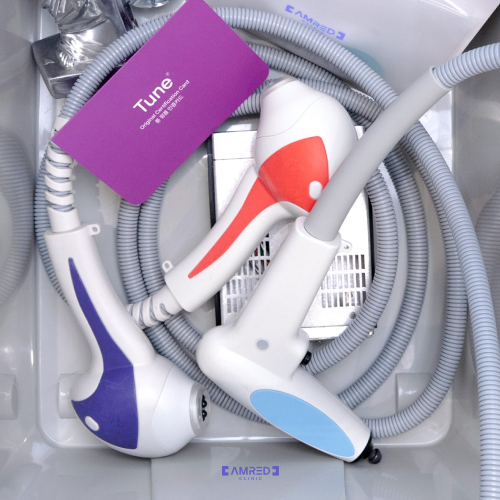
The Tune series utilizes high-frequency and ultrasound technology from the Accent Prime platform, and the actual functions and handpieces used vary according to the treatment purpose. Understanding the differences in the actual technology and applicators used in the program clarifies the treatment objectives.
First, it's important to understand that even under the name 'Tune', the applicators and their purposes can differ. The starting point is not to assume that the same energy is delivered just because of the product name.
How do the roles differ depending on the handpiece?
Even within the same equipment platform, the way energy is delivered to the skin and the goals can differ based on the characteristics of the applicator. Even if the program name is the same, the actual applicators used can vary, which is an important condition when explaining application depth and areas.
Terms like Tune Blue and Tune Red can be mixed with program descriptions and equipment functions from different clinics. The methods used for managing skin elasticity on the face and those considering localized fat and contours have different goals, making it difficult to connect handpiece names with a uniform list of effects. In actual treatments, it's advisable to specifically check the name, function, and application area of the handpiece you intend to use.
The Accent Prime platform is equipped with various applicators that utilize high-frequency and ultrasound. Not all handpieces operate at the same depth and purpose, so distinguishing the differences in function is the starting point for combination design.
It is advisable not to generalize that one type is necessarily deeper or stronger than another without checking specifications.
Where are Tune Blue, Tune Red, and Tune Liner applied?
Tune Face varies in the depth of energy application and purpose depending on the type of handpiece used. Notably, Tune Blue, Tune Red, and Tune Liner are utilized for different concerns such as skin elasticity, fat, and facial contours.
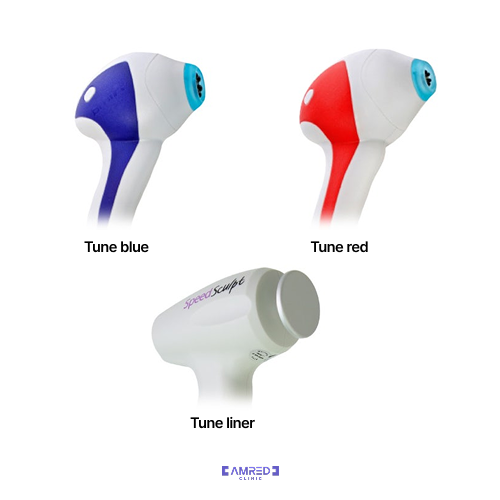
Tune Blue is a handpiece designed to deliver high-frequency energy to relatively deep tissues, used in areas where skin and tissue elasticity have decreased, such as the cheeks and jawline. It induces a thermal response in the skin to expect collagen remodeling and elasticity improvement.
Tune Red is designed to deliver energy to relatively shallow tissues, used in areas like under the eyes or around the mouth where the skin is thin and requires detailed care. It can be considered for concerns like fine lines or decreased skin elasticity.
In contrast, Tune Liner uses ultrasound energy rather than high-frequency, and is used for managing localized fat and facial contours, such as double chins or deep cheeks. There are differences in energy methods and application purposes compared to Tune Blue and Tune Red, which focus on improving skin elasticity.
For example, if the skin under the eyes is thin and fine lines are a concern, and there is fat under the chin making the jawline look heavy, different treatment methods are needed. Even on the same face, decreased elasticity in the cheeks and a double chin can occur simultaneously, allowing for the application of suitable handpieces for each area.
This characteristic of Tune Face allows for the use of different handpieces depending on the area to be improved and the skin condition.
Why combine Tune Face handpieces?
Using two or more applicators does not necessarily guarantee better results. The application purpose of each device, treatment range, and skin condition must be considered together.
Having multiple handpieces included in a program does not automatically mean it is better. If there are sufficient methods for a single goal, there is no reason to add unnecessary functions, and if the issues in multiple areas differ, combinations can be considered. Rather than emphasizing the quantity of '11 Tune handpieces', it is more helpful for consumer understanding to show the actual functions used, treatment areas, and purposes.
When both decreased skin elasticity and localized contour concerns appear simultaneously, different methods can be applied to share roles. However, simply adding functions that overlap for the same concern distances the composition from the meaning of customized treatment.
For example, if the roles are distinguished by managing the elasticity of one area and examining the contour of another, it becomes easier for consumers to understand the plan. The actual goal is more important than the 'name' of the combination.
Do pain and treatment conditions differ depending on the handpiece?
Tune Face may have differences in the sensations felt during treatment depending on the applicator and energy method used. During the high-frequency process, sensations like heat or tenderness may occur, and the degree of discomfort can vary depending on the application area and skin condition.
When the type of handpiece changes, the area of application and goals can also differ. Therefore, it is difficult to explain treatment conditions uniformly when managing narrow and detailed areas versus considering broader areas like cheeks and jawlines.
After treatment, temporary redness or swelling may occur. Additionally, if other energy-based treatments have been received recently, it is important to review whether the stimuli delivered to the skin overlap. This is why the comfort of the treatment cannot be simply predicted by the name of the handpiece.
How does AMRED design Tune Face combinations?
The advantage of Tune Face is not simply in using many applicators. It is important to distinguish what functions are needed for different concerns, such as decreased elasticity in the cheeks and changes in the jawline.
AMRED considers the density of the skin and tissues, detailed changes, and the overall balance of the face based on 4D aging resolution. The energy methods and applications required for each facial area are applied differently to meet the desired needs.

Based on this, the combinations of necessary applicators and treatment ranges are designed. It is more important that the reasons for each application are clear than simply the fact that multiple ones are combined, and the combination that aligns with current facial concerns is what AMRED aims for in Tune Face.
4D refers to AMRED's own perspective on aging analysis and treatment design, and does not signify an independent medical diagnostic classification or a single treatment name.
Actual treatment plans may vary based on the medical staff's examination and individual conditions.