
Cheongdam Tune Face | What is Tune Dual? A Combination of Two Methods and Considerations
2026-10-27
Contents
Are Tune Dual and Tune Parallel the same treatment?
When exploring Tune Face, you may encounter terms like Tune Dual and Tune Parallel, which distinguish themselves from the general Tune Face. While all are related to Tune treatments utilizing Accent Prime, it is essential to understand the differences in program composition and actual treatment methods.
Tune Dual is one of the Tune program names used at AMRED. In contrast, Tune Parallel is AMRED's treatment method that utilizes two Accent Prime devices simultaneously.
In particular, the distinction of Tune Parallel lies not in adding different energies. The key difference is in the process of delivering energy to both sides of the face simultaneously and varying the treatment time.
Why does Tune Parallel use two Accent Prime devices?
A typical Tune Face treatment can be performed by first treating one side of the face and then moving to the other side. In this case, while energy is being delivered to one side, the other side has not yet begun treatment.
AMRED's Tune Parallel is designed to manage both sides of the face simultaneously using two Accent Prime devices.
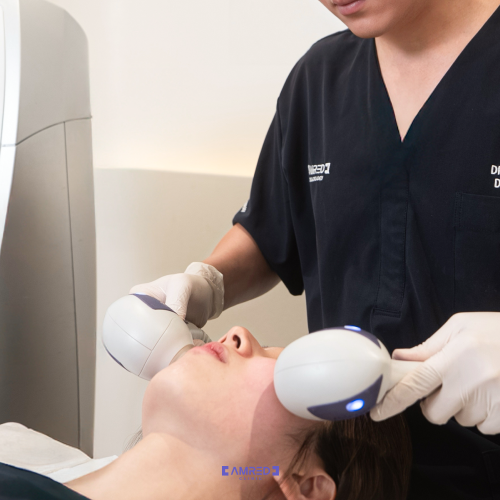
By applying each device to both sides of the face, the process of moving from one side to the other is reduced.
This difference pertains to the order and timing of the treatment. Using two devices does not mean that completely different energies are delivered simultaneously like lasers and radiofrequency, nor does it imply that double the energy is applied to one area. The actual energy settings and handpiece configurations are determined according to the treatment plan.
What is the difference between treating one side at a time and treating both sides simultaneously?
In radiofrequency lifting, energy is delivered to the tissue, causing a thermal reaction. The temperature of the treated area changes over time, making the timing and order of energy delivery an element of the actual treatment process.
If one side of the face is treated first and then the other side is addressed, there will be a difference in the starting points of treatment for both sides. In contrast, Tune Parallel allows for simultaneous treatment, reducing this time difference. This is also why AMRED operates Tune Parallel as a distinct treatment method.
However, simultaneous treatment does not guarantee that the temperatures of the left and right tissues will be identical or that the lifting results will be symmetrical. The thickness of the skin, amount of fat, and degree of elasticity loss may differ on both sides. Even with the same treatment method, the actual application conditions must be assessed based on the state of each side.
Is the treatment time shorter with Tune Parallel compared to regular Tune Face?
Treating both sides of the face simultaneously may reduce the time needed to deliver energy compared to managing each side sequentially. This is one of the practical differences of using two devices in Tune Parallel.
However, treatment time is not always exactly halved. If the area to be treated on the face is extensive or if different handpieces need to be used for areas like the eyes, cheeks, or jawline, additional time may be required. Diagnosis, treatment design, preparation, and finishing processes are also included in the total time required.
Therefore, when comparing treatment times, it is essential to consider not only whether the treatment is simultaneous but also which areas are being managed and to what extent. Even with the same Tune Parallel method, the actual time required may vary based on individual application ranges.
Does using two devices simultaneously double the lifting effect?
Having two devices does not mean that the energy delivered is doubled or that skin elasticity improves twofold. Tune Parallel is not about simply adding energy to the same area but rather about changing the method of delivering energy to both sides of the face.
The response to lifting is influenced not only by the heat transfer during treatment but also by skin thickness, tissue condition, the handpieces used, energy settings, and the areas being treated. Even if both sides are treated at the same time, the necessary conditions for each side may not be the same.
Therefore, when choosing Tune Parallel, it is more realistic to assess the characteristics of simultaneous treatment and the specific treatment range needed rather than expecting effects to simply multiply. It is advisable to examine whether it is a method that can shorten time and whether it is tailored to actual skin concerns.
How does AMRED utilize Tune Dual and Tune Parallel?
AMRED operates Tune Parallel as a simultaneous treatment method utilizing two Accent Prime devices. Even when conducted simultaneously, the same energy and handpieces are not applied to all areas of the face.
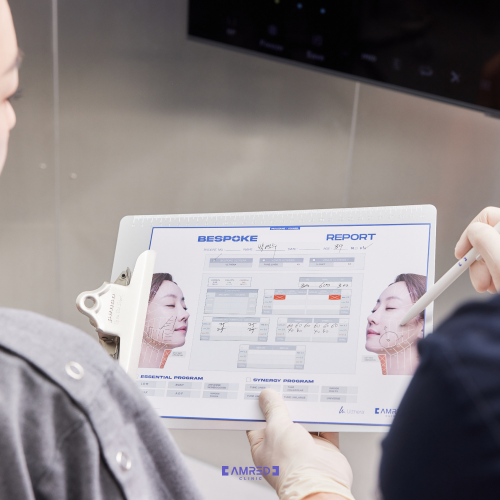
For example, if the degree of elasticity loss differs between the right and left cheeks, or if there is more noticeable fat and skin sagging on one side of the jawline, the conditions of both sides must be assessed individually. Areas requiring detailed care, like around the eyes, may require different handpieces and ranges compared to broader areas like the cheeks.
AMRED develops treatment plans based on 4D aging resolution, examining skin and tissue density, changes by area, and facial balance. According to that plan, handpieces and application ranges are determined, and in the case of using Tune Parallel, a simultaneous treatment method is applied. The differences observed in Tune Dual and Tune Parallel are more about the actual treatment methods and individual design details than the treatment names themselves.
4D refers to AMRED's proprietary perspective on aging analysis and treatment design, and does not signify an independent medical diagnostic classification or a single treatment name.
Actual treatment plans may vary based on the medical staff's diagnosis and individual conditions.