
Cheongdam ONDA Lifting | ONDA 10kJ, Can We Judge Treatment Amounts by Numbers Alone?
2026-10-27
Contents
What is the treatment amount of ONDA 10kJ?
When searching for ONDA lifting, you may come across programs categorized by energy amounts such as 10kJ, 20kJ, and 60kJ. In particular, 10kJ is often presented at a relatively low cost, making it one of the options that those considering ONDA for the first time are interested in.
The kJ of ONDA indicates the total amount of energy delivered during the treatment process. However, it is not a method of counting the number of shots like with Ultherapy, and it is distinct from the output unit that indicates how strongly energy is delivered.
In actual clinics, 10kJ is sometimes used for programs applied to relatively small areas or as an addition to the energy amount in existing treatments. On the other hand, programs that manage multiple areas such as double chin and jawline may consist of a larger amount of energy.
Therefore, it is difficult to understand ONDA 10kJ as a fixed treatment amount that can sufficiently manage the fat and elasticity of the entire face. The required amount of energy can vary depending on the area to be managed, the thickness of the fat layer, and the improvement goals.
Can ONDA 10kJ also manage double chin or cheek fat?
ONDA is a treatment that utilizes ultra-shortwave energy to target local fat and skin elasticity, and it can also be used on areas that affect facial contours, such as double chin or cheek fat.
For example, if fat is concentrated under the chin, making the double chin prominent, contour improvement can be planned targeting the fat layer in that area. Conversely, if fat is distributed not only under the chin but also below the cheeks, making the entire lower face appear heavy, the range to be managed expands.
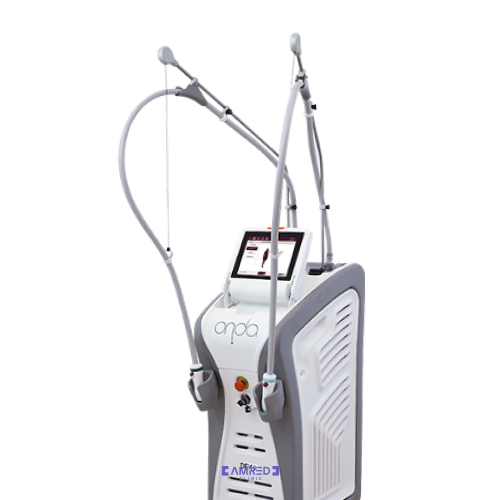
In this way, the required treatment amount may not be the same for areas with concentrated fat versus those that appear across multiple areas.
However, it is difficult to predict the fat reduction or contour improvement effect of a specific area based solely on the energy amount of 10kJ. This is because the actual thermal response in the tissue is influenced by various conditions such as the range of energy delivered, output, and application time.
Additionally, the reason a face may appear chubby is not necessarily due to the amount of fat. If the elasticity of the skin and supporting tissues decreases, causing the lower cheeks to sag, the need for both fat reduction and elasticity improvement should be considered.
Thus, ONDA is not simply a treatment that reduces the volume of the face; rather, the necessary contour improvement direction can vary depending on the state of fat and elasticity.
Does the treatment method change even with the same 10kJ?
Even when using the same 10kJ, the depth and method of energy delivery can result in different responses in the tissue.
ONDA utilizes equipment that uses 2.45GHz ultra-shortwave energy, applying Coolwaves technology to deliver thermal energy to the skin and subcutaneous fat layer.
It employs handpieces designed to deliver energy at different depths depending on the application area and purpose.
The Shallow handpiece, which acts on relatively superficial tissues, is used for managing skin elasticity and shallow fat layers, as well as double chins, while the Deep handpiece is utilized for localized fat management in relatively deep fat layers, such as in the abdomen or thighs.
Additionally, a contact cooling system is applied during the treatment to control excessive heat rise on the skin surface.
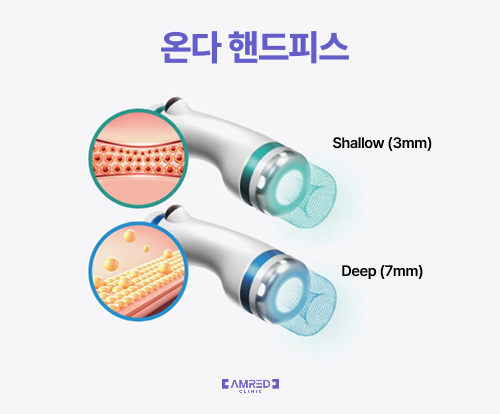
What needs to be distinguished here is the total energy amount and the conditions under which actual energy is delivered. Even with the same 10kJ, the manner in which thermal energy is delivered can vary depending on output, exposure time, and the type of handpiece used.
ONDA is a treatment where not only the total amount of energy but also how heat is delivered to which tissue layer is important. Therefore, even with the same 10kJ program, the treatment configuration can vary depending on the actual application conditions.
Will increasing the energy amount of ONDA enhance the effects?
ONDA lifting can sometimes be completed in one session, but it may also be performed over multiple sessions depending on the condition of the skin and fat layers and the improvement goals.
ONDA is a treatment that utilizes thermal energy to affect fat tissue and skin elasticity. These changes in tissue do not all occur immediately after the treatment but may appear over time.
Therefore, applying a large amount of energy in a single treatment is not the same as performing repeated treatments at regular intervals. By conducting multiple sessions, the range and energy amount for the next treatment can be adjusted based on the skin response and contour changes observed after the previous treatment.
For example, if fat reduction under the chin is the main goal, the contour changes can be observed after treatment, and the need for additional management can be assessed. If there is still a decrease in skin elasticity, additional ONDA treatments or other methods for elasticity management may also be considered.
Conversely, if sufficient changes are observed in the initially planned area, there may be no need to repeatedly apply the same amount of energy.
Thus, the number of ONDA treatments should not be understood merely as dividing the total energy amount into several parts but as a process of gradually continuing necessary management while observing changes in the skin and fat tissue.
What is the difference between receiving ONDA once and multiple times?
Comparing ONDA 10kJ and 20kJ, 20kJ corresponds to double the total energy amount. However, just because the energy amount is doubled does not mean that the effects of fat reduction or skin elasticity improvement will also be exactly doubled.
Increasing the energy amount can be a way to widen the range that can be managed or to deliver additional energy to the necessary areas. However, the actual responses in the tissue can vary depending on the thickness of the fat layer, skin condition, and application conditions.
For example, if the fat in the double chin is prominent and the jawline needs to be managed as well, a relatively wide range can be targeted for energy planning.
Conversely, if there is not much fat and the focus is on skin elasticity reduction, it may be more appropriate to consider approaches suitable for elasticity management rather than simply increasing the energy amount.
Especially in faces that already lack volume, adding energy solely for fat reduction may not align with the desired contour improvement.
In ONDA treatments, the energy amount is not a number that directly indicates the magnitude of effects but rather a planned element for delivering thermal energy to the necessary tissues. It is important to consider both securing sufficient treatment amounts and avoiding unnecessary increases in energy.
How does AMRED plan the energy amount for ONDA?
AMRED emphasizes an approach that considers the current distribution of fat in the face, skin elasticity, and overall contours rather than applying a fixed energy amount uniformly in ONDA treatments.
For example, even for the same concern of double chin, it is important to distinguish between cases where the volume of fat under the chin is large and cases where the skin has loosened, causing the jawline to blur. The treatment goals and application range may differ depending on whether reducing fat is the priority or if elasticity improvement needs to be considered as well.

To examine these differences, AMRED utilizes a 4D aging resolution as a standard for treatment design. This involves considering the density and volume of the skin and tissues, detailed aging changes, and the overall balance of the face to explore the necessary improvement direction for each individual.
Based on this, areas that require fat management and those that need to maintain existing volume are distinguished, and the handpiece and energy application range are planned according to the skin condition.
If both elasticity reduction and localized fat are present, a wider range of ONDA treatments or additional management may be necessary, and combinations with other lifting methods may also be considered based on the skin condition.
AMRED's 4D ONDA lifting focuses not merely on providing a fixed energy amount but on designing the necessary energy and treatment range according to the individual's facial condition and improvement goals.
4D is a proprietary aging analysis and treatment design perspective defined by AMRED and does not refer to an independent medical diagnostic classification or a single treatment name.
Actual treatment plans may vary based on the medical staff's diagnosis and individual conditions.