
Cheongdam ONDA Lifting | What is the Difference Between ONDA and Shurink, and What Criteria Should Be Used for Double Chin Management?
2026-10-27
Contents
Are ONDA and Shurink the Same Procedure for Double Chin?
ONDA and Shurink Universe are often introduced as double chin lifting procedures, but there are differences in the energy used and the approach taken. Double chin can manifest due to various factors, including the thickness of fat, skin elasticity, and the structure of the jaw.
While people searching for solutions to double chin often look for both ONDA and Shurink, one is based on microwave technology and the other on focused ultrasound, indicating that their principles differ. Therefore, grouping them as 'both are lifting procedures for reducing chin fat' can make it difficult for consumers to obtain the necessary information. The starting point for choosing between them is whether the volume of fat is the main issue or if the skin under the chin has loosened due to loss of elasticity.
Especially if one assumes that all reasons for a prominent double chin are due to fat, the choice of procedure may be misguided from the beginning. It is advisable to examine whether the appearance of excess fat is due to volume, skin laxity, or the structure of the jaw.
How Do Microwave and Focused Ultrasound Differ?
ONDA uses microwave technology, while Shurink employs focused ultrasound. Both methods induce thermal reactions, but the way energy is delivered and the application conditions for each device are not the same.
Shurink, which is ultrasound-based, may vary in depth and method depending on the product model and handpiece used. ONDA delivers microwave energy, so the irradiation method and energy units are also different. It is not possible to compare the number of shots and kJ of different devices on the same scale or to understand that 'higher energy means greater effectiveness.' The differences in the scope of treatment and application methods can also be reflected in the cost structure.
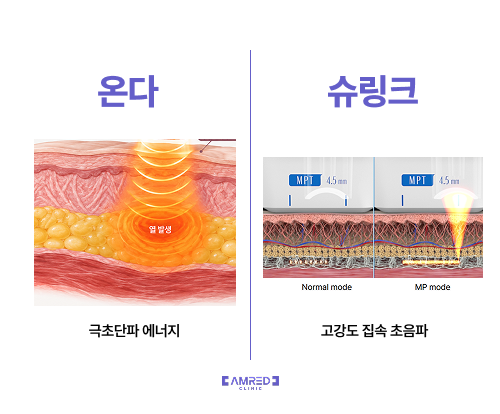
Shurink uses focused ultrasound to create thermal coagulation points at the selected target depth. ONDA differs in that it utilizes the thermal response of microwaves, and the roles of the two methods vary based on the condition of the tissue in the area of concern, not just their names.
Shurink also has various models and cartridges, so it is advisable not to assume that they are all under the same conditions just because they share the same procedure name. The energy values of the two devices also make simple size comparisons difficult.
What Causes a Blurred Jawline?
When there appears to be excess fat under the chin, it can be approached differently than when the skin is loose and the boundaries are blurred. In a face lacking volume, it may not be appropriate to uniformly aim to reduce contours, as other areas of hollowness should also be considered.
For individuals with thick submental tissue and relatively maintained skin elasticity, and those whose skin under the jawline has sagged without any weight change, the goals for addressing double chin differ even if they are both referred to as double chin. The structure of the jaw and the angle of the neck also influence how prominent the double chin appears. Information explaining which factors are primarily managed is more useful than advertisements claiming to solve all causes with a single procedure.
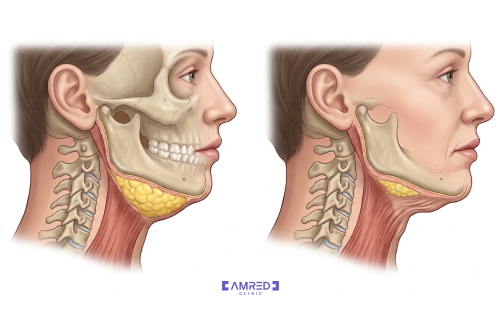
The reasons for a blurred jawline involve not only the amount of fat under the chin but also skin laxity, the boundary of the jaw structure and neck, and differences in surrounding volume. Different causes exist within the same concern of double chin.
If the boundary under the chin has not become distinct after weight loss, it is worth examining whether skin elasticity or facial shape also plays a role.
Can ONDA and Shurink Be Used Together?
Even when applying ONDA and Shurink simultaneously, it is essential to individually assess whether their purposes overlap and whether the skin condition can handle it. Combining multiple energies does not automatically guarantee better results.
For example, if a concern can be sufficiently addressed with one procedure, it is not always necessary to resort to a combination treatment. As the number of procedures increases, costs, precautions, and recovery processes must also be considered separately.
Receiving both treatments simultaneously for concerns about the jawline is not always advantageous. Even if both the volume of fat and skin laxity are observed, it is crucial to first check whether the application ranges of the two methods overlap and whether there are areas of the skin that may be burdened.
Why is the Scope of Treatment Important in Double Chin Management?
The scope of treatment in double chin management using ONDA and Shurink is a crucial condition for understanding the results. A plan that only addresses the area directly below the jaw differs in the actual range of tissue being treated compared to a plan that considers the area extending from the jawline to the neck.

For example, if the concern is localized volume under the chin, the central area that needs treatment may be relatively clear. In contrast, if the skin has loosened from below the cheeks to the jawline, it is necessary to examine the connections between multiple areas rather than focusing on a single volume.
When considering both devices, it is also essential to distinguish which areas each energy will be applied to and what changes are expected. In cases where thermal stimulation overlaps in the same area, planning that considers skin condition and recovery processes is crucial.
How Does AMRED Design Double Chin Treatments?
Even with the same concern of double chin, a face with concentrated fat layers under the chin and a face with loose skin resulting in a blurred jawline may require different approaches. The structure of the jaw and the distribution of volume in the cheeks are also factors that can alter the appearance of the facial line.
AMRED examines the harmony of facial density, volume, and overall contour based on 4D aging resolution. When reviewing ONDA and Shurink, we distinguish which tissue and area each device's energy targets.
Rather than automatically combining both treatments or uniformly recommending one, we prioritize planning the necessary areas and depths based on the actual causes of concern.
4D is a proprietary aging analysis and treatment design perspective defined by AMRED and does not refer to an independent medical diagnostic classification or a single treatment name.
Actual treatment plans may vary based on the medical staff's examination and individual conditions.