
Cheongdam ONDA Lifting | Differences Between ONDA and ALLTITE, Energy Methods and Selection Criteria
2026-10-26
Contents
What are the differences between ONDA and ALLTITE?
ONDA and ALLTITE are both compared for elasticity and contour management purposes, but the actual energy methods differ. It can be confusing to think of them as similar high-frequency treatments just by their names.
Those searching for ONDA and ALLTITE usually have similar goals of 'wanting to improve elasticity while managing the fat under the chin.' However, the ultrashort wave energy of ONDA and the high-frequency energy of ALLTITE have different equipment configurations. Just because they fall under a similar lifting category does not mean their effects on fat and elasticity are exactly the same. It is important to distinguish which tissues and concerns each targets.
For example, concerns about a thick appearance under the chin and feeling that the skin around the cheeks is lacking firmness may seem similar on the surface, but the causes can be different. It is crucial to identify what actual changes are needed before choosing a treatment.
How do ultrashort waves and dielectric heating methods differ?
ONDA delivers energy through ultrashort waves, while ALLTITE is based on high-frequency energy. The handpieces and application conditions may differ, so simply comparing which one is deeper or stronger is not sufficient.
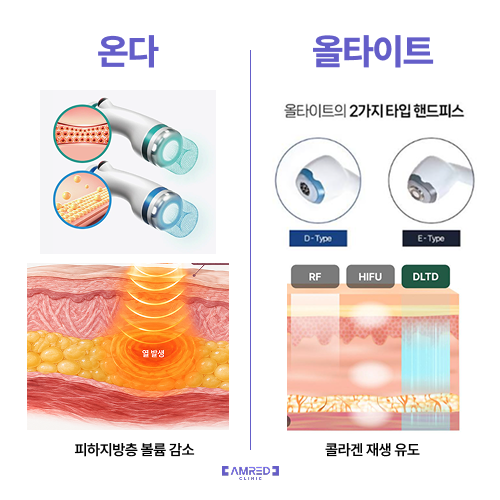
ONDA is an equipment that considers the thermal response in the skin and fat layers based on the handpiece and application range, while ALLTITE is utilized for skin elasticity and contour management with dedicated high-frequency equipment. Even if some promotional materials state that 'it does not touch fat' or 'tightens all layers,' it cannot be generalized without checking the product specifications and actual application conditions. The differences between the two devices are revealed in the treatment goals, the handpieces used, and the actual application conditions.
ONDA utilizes ultrashort waves equivalent to microwaves, while ALLTITE is introduced as a focused dielectric heating method. To understand the differences, it is essential to distinguish the designed methods of energy application and the targeted areas rather than grouping the principles of the two devices together.
Rather than concluding that a specific treatment goes deeper or is stronger based on a single sentence, it is more helpful to first consider what goals you expect from your current skin condition.
If double chin is a concern, will the approach differ?
Depending on whether the fat under the chin appears prominent or the skin looks saggy, the direction of consideration may change. If the distribution of fat is the main concern versus the loss of elasticity, addressing them with the same plan may lead to different expected changes.
For example, a person with a thick under-chin and someone whose cheeks are already sunken may express similar concerns about facial contours, but their desired changes differ. The former may need to address the volume of the fat layer, while the latter may need to preserve the lacking volume while examining skin elasticity. Applying a fat reduction-focused approach to the entire face may risk disrupting harmony, so each area should be explained separately.
Describing from which angle the changes are most pronounced and how the appearance differs when tilting the head up versus down can be helpful for consultations. It is not always necessary to repeat treatments on the same area with multiple devices.
What differences are important for skin elasticity loss?
When the skin on the entire face feels lackluster, it is essential to assess the skin condition and the degree of elasticity loss. While it is helpful to note that high-frequency and ultrashort waves have different characteristics, it is not possible to conclude that one device is inherently more natural than the other.
Especially in a face that already appears sunken, reducing contours may lead to an impression that differs from what is desired. This is why it is necessary to consider the entire face along with the treatment area.
If the cause of a sagging jawline is the loss of skin elasticity, it may be difficult to achieve the desired facial contour with an approach focused solely on reducing the volume of the fat layer. Conversely, if a lot of volume is concentrated under the chin, managing only the surface elasticity may not be sufficient.

When comparing the two treatments, it is advisable to specify the expression 'the skin has sagged' a bit more. Depending on whether the cheek skin feels lackluster or the volume under the chin is prominent, the explanation of which energy targets which area should differ.
How do the number of treatments and pain differ between the two procedures?
Both treatments may cause warmth, temporary redness, and discomfort. Caution is needed regarding expressions that suggest multiple sessions must be purchased in advance to maintain effectiveness or that a single treatment will resolve all concerns.
When combining the two devices, the roles of each treatment must be clear. If skin elasticity is the main concern, there is no reason to add a plan focused on fat reduction. Conversely, if the issue of prominent fat in certain areas is significant, it is necessary to consider whether skin tightening alone can meet expectations. It is more rational to confirm the necessity of each step rather than focusing on package configurations.
Additionally, the necessity for repeated treatments should be determined after assessing individual conditions and progress. It is advisable not to accept the number of sessions presented on the price list as a mandatory condition for effectiveness.
How does AMRED differentiate between ONDA and ALLTITE?
Since ONDA and ALLTITE deliver energy differently, the criteria for consideration may vary even for the same sagging concerns. The face with a prominent under-chin and the face with loss of elasticity in the cheek skin have different desired changes.
AMRED examines volume, density, detailed changes, and harmony of facial contours based on a 4D aging resolution. Through this, rather than simply aiming to make the facial contour slimmer, we review the appropriate energy methods for the tissues and areas that genuinely need improvement.
It is an important aspect of AMRED's customized treatment design to distinguish the application purposes based on the condition of the skin and soft tissues rather than comparing different devices solely within the same 'lifting' category.
4D refers to AMRED's own definition of aging analysis and treatment design perspective and does not signify an independent medical diagnostic classification or a single treatment name.
Actual treatment plans may vary based on the medical staff's examination and individual conditions.