
Cheongdam Onda Lifting | What is Onda Lifting? Characteristics of High-Frequency Energy
2026-10-26
Contents
What is Onda Lifting?
Onda Lifting is a procedure that uses ultra-short wave (microwave) energy. Although it is called lifting, the method of energy delivery differs from other ultrasound and high-frequency devices.
If Onda is introduced only as 'high-frequency lifting', it may lead to misunderstandings about its operating mechanism.
Onda utilizes ultra-short wave (microwave) energy, making it difficult to explain in the same way as other RF devices.
The amount of heat delivered to the skin and subcutaneous fat can vary depending on usage tips and application areas. It is necessary to distinguish whether my concern is about fat volume or skin elasticity before focusing on the energy name.
People often inquire about it when they are concerned about facial contours or body silhouettes, but the actual application range should be determined after assessing the device, handpiece, and the patient's condition.
How does Onda deliver energy to the skin?
Onda delivers ultra-short wave energy to the tissue, causing a thermal reaction. It is used to manage skin elasticity and address contour issues in localized areas, but it does not guarantee that all fat will reduce uniformly or that the skin will be immediately tightened.
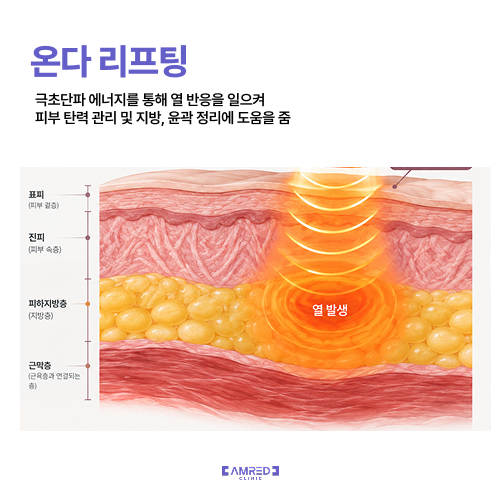
The face and body have different tissue thicknesses and management goals. Concerns about localized volume under the chin cannot be compared to broader fat and elasticity issues in the abdomen using the same energy amount.
Depending on the usage tips and application range of Onda, the way energy is delivered to the skin can vary, making it difficult to determine treatment intensity based solely on 'how many kJ'.
Onda's ultra-short wave is utilized to induce thermal reactions in the tissue. Since the principles of energy delivery differ from the unipolar RF of Thermage or the focused ultrasound of Ultherapy, it is challenging to describe the action areas as the same just because they are all called lifting.
Rather than thinking of Onda as a device that 'absolutely eliminates fat', it is essential to confirm whether the current concern relates to fat distribution or changes in elasticity.
What differences can be expected from Onda lifting on the face and body?
Onda lifting can be applied not only to the face but also to areas such as the arms, abdomen, and thighs. Although the same ultra-short wave energy is used, the expected changes and treatment methods differ due to variations in fat layer thickness and skin condition in different areas.
Facial Onda is primarily used to refine facial contours by considering localized fat accumulation and skin elasticity, such as double chins or cheek fat. For example, if a double chin is prominent due to fat under the chin, contour improvement can be planned by examining the fat and skin condition in that area. Conversely, if the face lacks volume or already has hollow cheeks, an approach may be needed to manage elasticity while maintaining existing volume rather than reducing fat.
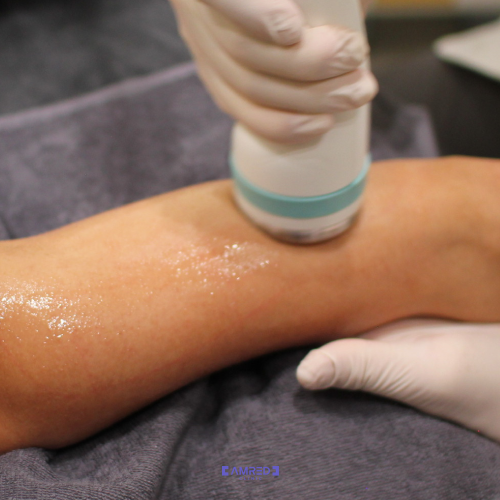
Body Onda is used to address localized fat accumulation, decreased skin elasticity, and cellulite improvement in areas such as the arms, abdomen, and thighs. For instance, if there are concerns about localized fat in the abdomen or uneven skin surfaces on the thighs, heat energy can be delivered to the fat layer and surrounding tissues to expect changes in body contours and skin condition.
Thus, Onda utilizes different handpieces depending on the tissue thickness and purpose of the treatment area. When managing relatively shallow tissues like double chins and approaching thicker fat layers like those in the abdomen and thighs, the handpiece and energy application range may differ.
How does Onda differ from high-frequency and ultrasound lifting?
Onda, Ultherapy, and Thermage are all devices mentioned in non-surgical lifting, but the methods of delivering energy to the tissue differ. Onda uses ultra-short waves, Ultherapy uses focused ultrasound, and Thermage employs unipolar high-frequency.
The difference in energy methods means that the action conditions considered in the skin and tissue also vary. For example, if the area under the chin appears thick and the skin is loose, causing the facial contours to blur, the management goals may differ even if the contour concerns are the same.
It is important to distinguish whether Onda is being viewed as a simple alternative procedure to other lifting methods or whether it is focused on managing changes in tissue volume and skin elasticity. Rather than evaluating which device is necessarily stronger among several, the appropriate approach varies depending on the condition of the area in question.
What discomfort might occur during the Onda procedure?
Heat sensations, temporary redness, and discomfort may occur, varying by treatment area and individual condition. If unexpected skin changes occur after the procedure, it is essential to contact a medical institution for evaluation.
During the procedure, heat sensations or discomfort may arise, and after the procedure, temporary redness and swelling should be considered. Especially if planning to treat both the body and face on the same day, the precautions and recovery processes for each area may not be the same. It is advisable to avoid definitive statements such as 'there are no side effects because of cooling technology' or 'it precisely eliminates fat.'
What concerns does AMRED consider for Onda lifting?
The purpose of applying Onda lifting varies depending on why an area appears thick. Even if the fat layer under the chin is relatively thick and the skin along the jawline is loose, the management goals may not be the same despite similar appearances.
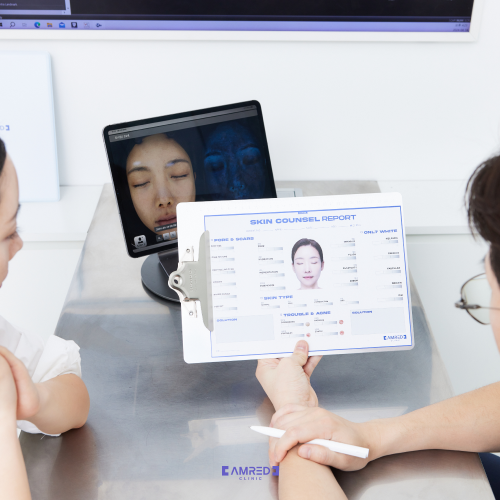
AMRED examines the distribution of volume, skin elasticity, and overall facial balance based on 4D aging resolution. When reviewing Onda's ultra-short wave energy, it is essential to first distinguish which tissue changes are involved in the current concerns rather than simply aiming for contour reduction.
Subsequently, the usage method and energy plan are reviewed based on the areas that require management and the application range. Even for the same Onda procedure, AMRED emphasizes the importance of an approach that does not disrupt the overall balance of the face.
4D is a self-defined perspective of aging analysis and treatment design by AMRED, and does not refer to an independent medical diagnostic classification or a single treatment name.
Actual treatment plans may vary based on the medical staff's diagnosis and individual conditions.