
Cheongdam Alltite | How Do the 200 Shots and 400 Shots Differ in Treatment Scope?
2026-10-26
Contents
What is the difference between Alltite 200 Shots and 400 Shots?
When looking into Alltite, the numbers 200 shots and 400 shots may catch your attention first. However, the number of shots only indicates the frequency of energy delivery, and it does not mean that the skin elasticity improvement effect is exactly double.
Alltite 200 shots and 400 shots represent the number of energy applications using the same equipment, but this cannot be interpreted as 'double the effect.' A plan focusing on one area differs from a plan that applies treatment to multiple areas of the face. Since not only the skin area but also the handpiece configuration, application method, and individual elasticity status vary, it is difficult to determine appropriateness based solely on the number of shots.
It is essential to consider which area is targeted, what handpiece will be used, and the actual range of treatment intended. Comparing only the number of shots in advertisements may omit crucial information.
When reviewing the treatment, it is important to look not just at the total number of shots but also at which areas are being focused on and what equipment and tips are being applied.
Do 200 Shots and 400 Shots refer to treatment areas?
The appropriate number of shots for Alltite can vary depending on the areas where elasticity loss is observed and the required treatment scope.
For instance, if the main concern is fine wrinkles around the mouth or elasticity loss in specific areas, a treatment plan focusing on those areas may be considered. Conversely, if the overall elasticity of the cheeks has decreased and the jawline has become less defined, a broader treatment scope may be necessary as multiple areas need to be addressed.
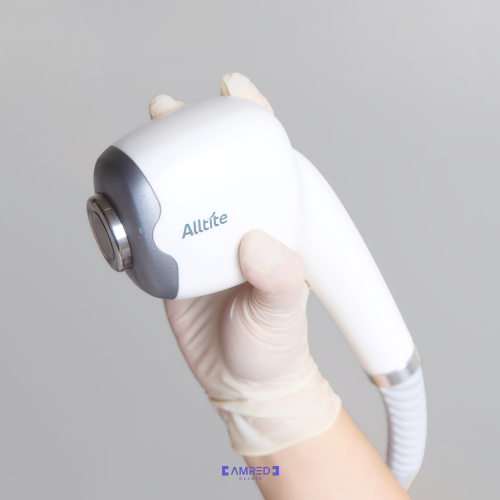
In such cases, a 200-shot configuration may be reviewed for relatively limited areas, while a 400-shot configuration may be considered if energy needs to be distributed across multiple areas. However, there is no fixed standard that states 200 shots are for partial treatments and 400 shots are for full facial treatments.
For example, even for the same concern regarding the jawline, if the loss of skin elasticity is concentrated in a specific area versus if it has loosened all the way down to the lower cheeks, the necessary treatment area and energy distribution may differ.
Additionally, if the area below the cheekbones appears sunken due to volume loss, a differentiated approach is needed to identify areas requiring elasticity improvement rather than uniformly applying energy across a wide range.
Ultimately, Alltite 200 shots and 400 shots are not simply a difference between fewer and more treatments. It is more appropriate to understand them as differences in the number of applications that can be considered when structuring the necessary treatment scope according to individual skin concerns and facial structure.
How does Alltite deliver energy?
Alltite is designed to deliver thermal energy to the skin's internal tissues using a high-frequency-based dielectric heating method.
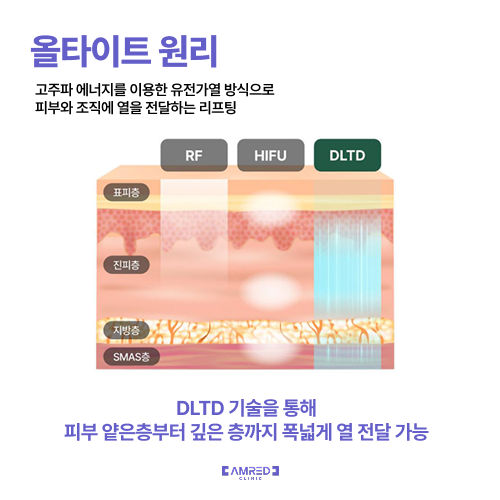
The DLTD (Dermis Layer Target Dielectric Heating System) applied in Alltite is a technology aimed at concentrating thermal energy on the dermis and the supporting tissues beneath it.
Dielectric heating generates heat within tissues that respond to electromagnetic fields. Alltite utilizes this principle to induce thermal reactions in tissues related to skin elasticity, and it is used to expect elasticity improvement through subsequent changes in tissues and collagen remodeling.
A cooling system is also applied to manage the thermal burden on the skin's surface. This is designed to suppress excessive temperature rises on the surface while delivering thermal energy to the internal tissues, thereby managing discomfort during the treatment.
This operational method is a technical characteristic of Alltite, but it does not mean that the same heat is delivered to all skin layers or that it has no effect on adipose tissue. The actual tissue response may vary depending on individual skin conditions and energy application conditions.
Alltite is a treatment that requires consideration of not only the number of shots but also the method of energy delivery, thermal management of the skin surface, and the actual application areas. Even with the same number of applications, the treatment configuration needs to differ, making accurate diagnosis and sufficient consultation essential.
Can the treatment plan differ even with the same number of shots?
Alltite can utilize different types of handpieces based on the skin condition of each area. Therefore, even with the same 400 shots, the treatment configuration may differ depending on which area is targeted and which handpiece is used.
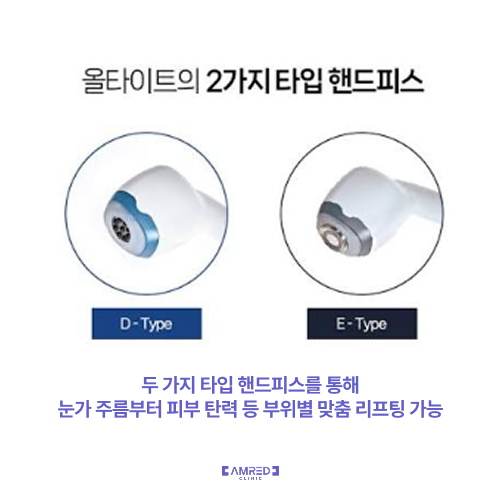
The D type used in Alltite is utilized for areas that require relatively precise approaches, such as around the eyes, mouth, and jawline, while the E type can be used for the cheeks, around the cheekbones, and areas considering the elasticity changes of broader tissues.
For example, if managing fine wrinkles around the mouth and overall elasticity loss in the cheeks, a different configuration is needed compared to treating just one area. This is because the range of handpiece use and the number of applications can be planned according to the skin condition of each area and the treatment goals.
Even within the same cheek area, it is essential to distinguish between overall loss of skin elasticity and cases where volume loss is prominent. In the latter case, simply delivering more energy may not be the most suitable approach.
Additionally, even with the same 400 shots, there is a difference in energy delivery location and range when applying it to the cheeks and jawline versus concentrating on a specific area.
Therefore, in the treatment plan, it is crucial to consider not only the total number of shots but also the characteristics of the handpiece, the skin condition of each area, and the range of energy application.
What changes and limitations can be expected from Alltite?
Alltite is a treatment that delivers high-frequency energy to the internal tissues of the skin to induce thermal reactions, expecting improvements in skin elasticity and tightening effects. However, even for the same facial sagging, the expected changes can differ based on the underlying causes.
For example, if the boundary between the cheeks and jawline has blurred due to decreased skin elasticity, improvements in skin and tissue elasticity can lead to a more defined facial contour. Conversely, if there is significant volume in the fat or a decrease in facial volume that alters the contour, it may be challenging to achieve the desired changes through elasticity improvement alone.
Changes around the mouth area are similar. Fine wrinkles appearing due to loosened skin and deeply set nasolabial folds may have different underlying causes. In particular, wrinkles that are significantly influenced by volume loss or facial structure may not see sufficient improvement through skin tightening alone.
Additionally, since Alltite is a treatment that expects changes through thermal tissue reactions and subsequent collagen remodeling, the sense of elasticity felt immediately after treatment may differ from changes perceived over time. The degree of improvement and duration of effects can also vary based on skin conditions and treatment conditions.
Therefore, when assessing the effectiveness of Alltite, it is important to distinguish whether the current concerns stem from decreased skin elasticity or if other tissue changes are also influencing the situation, rather than simply assuming that more shots will lead to greater changes. This is also the reason why energy needs to be delivered to areas suitable for the treatment goals.
How does Amred plan the number of Alltite shots?
Amred focuses on designing treatments by distinguishing between individual facial conditions and areas where elasticity loss occurs, rather than simply increasing the number of shots in Alltite treatments.
For instance, even if the concern is a blurred jawline, the necessary approach may differ depending on whether the skin's elasticity has decreased or if the tissue of the cheeks has sagged, altering the contour.
Moreover, if the area below the cheekbones already appears sunken, it is essential to consider whether uniformly applying energy to the entire cheek area is appropriate. This is because it is necessary to differentiate between areas that need elasticity improvement and those that need to consider existing volume.
To examine these differences, Amred utilizes a 4D aging resolution as a standard for treatment design. This involves considering the density and volume of the skin and tissues, detailed aging changes, and overall facial harmony to review the necessary treatment direction.
Based on this, medical professionals plan the areas and treatment scope that require elasticity improvement and review the application of D type and E type handpieces according to skin conditions. The number of shots is also determined based on this treatment plan.
Even with the same 200 shots or 400 shots, the locations and ranges where energy needs to be delivered can vary for each individual. For this reason, Amred prioritizes treatment design tailored to the structure of the face and aging patterns over a uniform application of shot numbers.
Amred's Alltite focuses on meticulously distinguishing the necessary areas and treatment scope based on the 4D aging resolution, and on structuring a shot number and energy application plan suitable for individual skin conditions.
4D refers to Amred's proprietary aging analysis and treatment design perspective and does not signify an independent medical diagnostic classification or a single treatment name.
Actual treatment plans may vary based on the medical professional's examination and individual conditions.