
Cheongdam Ultherapy | Differences Between Ultherapy and Shurink, Criteria for Choosing Ultrasound Lifting
2026-10-26
Contents
Are Ultherapy and Shurink the Same Ultrasound Lifting?
Both Ultherapy and Shurink are lifting procedures that concentrate ultrasound energy at a specific depth within the skin to create thermal coagulation points in the tissue. This thermal response induces collagen remodeling, which is utilized to improve skin elasticity and sagging.
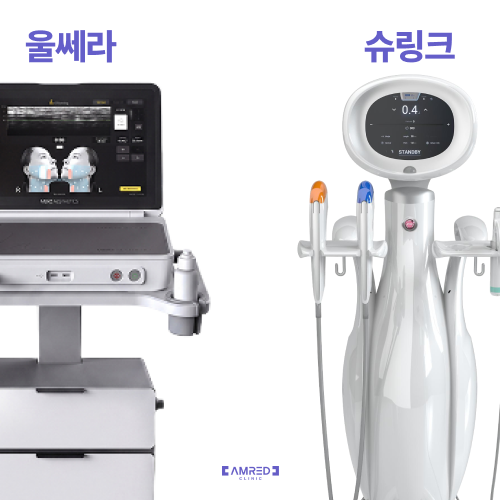
Both devices share the common feature of delivering energy to deep tissues without cutting the skin surface, but there are differences in how the energy is delivered and the functions that can be utilized during the procedure.
Ultherapy Prime is a micro-focused ultrasound (MFU-V) device that combines ultrasound imaging capabilities. It allows for real-time observation of the tissue layers within the skin, enabling a review of the treatment area and target depth.
In contrast, Shurink utilizes high-intensity focused ultrasound (HIFU), and the Shurink Universe is designed to adjust the treatment range and method through various cartridges and energy delivery modes.
Both devices can deliver energy at depths of 1.5mm, 3.0mm, and 4.5mm, so the claim that Ultherapy treats deeper layers is not accurate.
The actual difference lies in the method of observing the tissue within the skin and the way energy is delivered, rather than just the treatment depth. Even though they are both ultrasound lifting procedures, the planning and execution processes must differ.
What Role Does the Ultrasound Imaging of Ultherapy Prime Play?
The most significant feature of Ultherapy Prime is its DeepSEE ultrasound imaging technology, which allows for real-time observation of the tissue layers during the procedure.
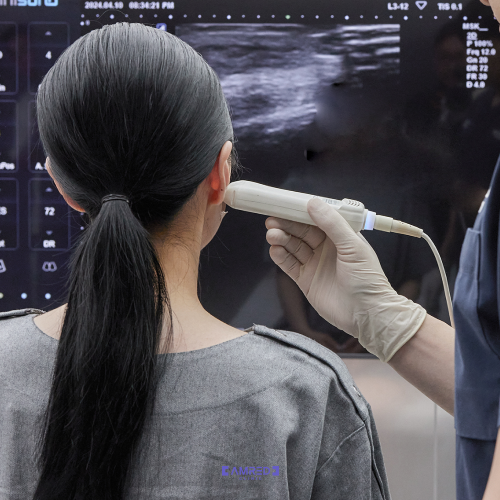
The thickness of the skin and fat layers varies across different areas of the face, and there are also differences in the depth at which the fascia (SMAS) is located. Even when delivering energy at the same depth of 4.5mm, it may not reach the same tissue layer in every person's face.
For example, consider a case where the soft tissue of the cheeks is thick, while the tissue along the jawline is relatively thin. If the same depth tip is applied to both areas, the actual location where the energy is concentrated and the surrounding structures may differ.
Ultherapy Prime allows for the observation of the tissue layers beneath the skin through ultrasound imaging, enabling the selection of the appropriate depth from the 1.5mm, 3.0mm, or 4.5mm tips based on the target tissue's location.
In particular, Ultherapy Prime can observe tissue up to a depth of 8mm through imaging. Here, 8mm refers to the depth that can be confirmed through imaging, while the actual depth of energy delivery varies depending on the tip used.
This imaging information is utilized to understand the structure of the treatment area and to plan where to deliver the energy.
Going beyond using a fixed depth tip, the ability to review the treatment plan after confirming the actual tissue layers is a technical differentiator of Ultherapy Prime.
How Does Shurink Work?
Shurink also delivers focused ultrasound energy to a specific depth within the skin to create thermal coagulation points, inducing thermal responses in the tissue and collagen remodeling.
Shurink Universe is an evolved model from the original Shurink, utilizing two energy delivery methods: Normal (Dot) mode and MP mode.
Normal (Dot) mode focuses energy in a dot pattern at regular intervals. MP mode is designed to quickly form denser thermal coagulation points and can be selected based on the treatment area and objectives.
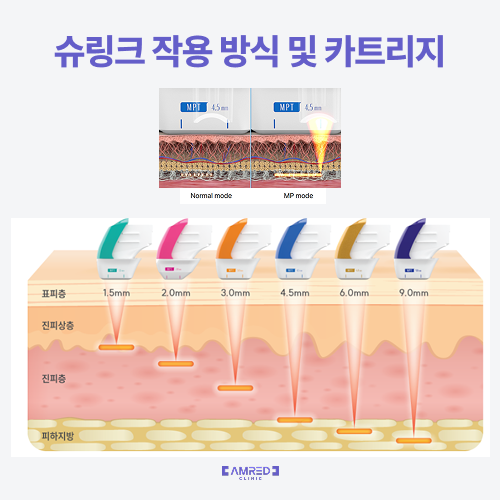
Additionally, Shurink Universe offers facial cartridges at depths of 1.5mm, 2.0mm, 3.0mm, and 4.5mm, along with a separate booster cartridge. This allows for different application conditions from narrow areas like around the eyes to relatively wider areas like the cheeks and jawline.
Unlike Ultherapy Prime, Shurink does not provide real-time imaging of the tissue layers during the procedure. Instead, it sets the depth, energy delivery mode, and application range based on the skin condition and anatomical characteristics evaluated before the procedure.
In other words, while Ultherapy Prime has strengths in imaging technology for observing tissue layers, Shurink Universe is characterized by its ability to utilize various cartridges and delivery modes.
Therefore, it is more appropriate to understand the differences in functionality and actual treatment planning rather than simply describing Shurink as a weaker ultrasound lifting compared to Ultherapy.
Why Does the Choice Vary Depending on Skin Condition?
Even with the same ultrasound lifting, the required treatment depth and range can vary based on skin thickness, fat distribution, and the location of sagging.
For example, if the skin and supporting tissues are sagging under the jawline, causing the facial contour to blur, one can consider examining the location of sagging and the tissue layers to deliver energy at the appropriate depth.
In such cases, the real-time imaging function of Ultherapy Prime helps in reviewing the appropriate tip and delivery location while confirming the actual target tissue layer.
On the other hand, if there are concerns about mild loss of elasticity across the entire face or if considering elasticity management focused on specific areas, devices like Shurink can also be included in the options. Shurink Universe can combine area-specific cartridges and delivery modes to structure the treatment plan.
However, if there is little fat on the face and the area below the cheekbones already appears sunken, the approach must change. In this case, it is important to consider not only the loss of elasticity but also the distribution of existing volume and facial contours. Careful planning of the treatment area and depth is crucial to avoid delivering energy beyond the necessary range.
Before selecting a device, it is essential to distinguish whether the current changes in the face are due to loss of skin elasticity, changes in the position of fat and supporting tissues, or if there is also a reduction in volume.
Even with the same lifting concerns, if the causes differ, the necessary treatment range and expected changes will also vary. The technical differences between Ultherapy and Shurink are significant in actual treatment planning.
How Do Pain, Cost, and Treatment Frequency Differ?
When comparing Ultherapy and Shurink, pain, cost, and duration of effect are also major considerations. However, these differences cannot be uniformly categorized based solely on the device names.
Both procedures deliver ultrasound energy to the target depth within the skin, which may cause sensations of tingling, sharpness, or a heavy pressure feeling inside the skin during the procedure.
The degree of pain is influenced by the treatment area, energy settings, and individual sensitivity. While Shurink Universe can utilize MP mode and rapid delivery speed, this does not necessarily mean it will be less painful for everyone compared to Ultherapy.
There are also differences in cost. Generally, Ultherapy Prime is often offered at a higher price point than Shurink. The two devices differ in terms of imaging capabilities, delivery methods, dedicated tips and cartridges, and the actual cost can vary based on the treatment range and number of shots at each clinic.
The duration of effect should also be examined separately. Both procedures utilize the thermal response of the tissue and subsequent collagen remodeling, so changes may appear gradually. However, the timing of perceiving effects and the duration of those effects depend on skin condition, treatment range and conditions, and individual aging progression.
Ultherapy may be planned as a single treatment followed by observation, while Shurink may be structured as a program including relatively short intervals of repeated management. This reflects the differences in operational methods that can be selected in actual practice, and since the same treatment frequency cannot be applied to all patients, it is essential to establish the treatment frequency through sufficient diagnosis and consultation.
How Does AMRED Design Ultherapy Prime?
At AMRED, we place as much importance on the process of deciding which area of the face to deliver energy to and at what depth as we do on the imaging capabilities of the equipment in Ultherapy Prime procedures.
Even for the same sagging jawline, it is essential to distinguish between cases where skin elasticity loss is the primary concern and those where volume loss and changes in the position of fat and supporting tissues are also present. Although the visible changes in the facial contour may be similar, if the causes differ, the necessary treatment approach will also vary.
To differentiate these variations, AMRED utilizes a 4D aging resolution that considers four depths and densities (DENSITY), details (DETAIL), design (DESIGN), and durability (DURABILITY) as the basis for treatment planning.
Based on this, we examine the condition of the skin and face through facial analysis and medical staff consultations, and plan the application area, depth, and number of shots while confirming the actual tissue layers with Ultherapy Prime's ultrasound imaging.
For example, if the goal is to improve sagging along the jawline, we check the tissue condition in that area to review the depth and range for energy delivery. Conversely, if an area already appears sunken due to volume loss, we may adjust the treatment range considering the overall balance of the face.
This approach aims to utilize the real-time imaging capabilities of Ultherapy Prime not just as a technical advantage of the device but to refine individual treatment plans.
AMRED's bespoke Ultherapy Prime focuses on finely distinguishing changes in the face based on the 4D aging resolution and designing treatments tailored to the necessary areas and depths.
4D is a proprietary aging analysis and treatment design perspective defined by AMRED and does not refer to an independent medical diagnostic classification or a single treatment name.
Actual treatment plans may vary based on the medical staff's evaluations and individual conditions.