
Cheongdam Dermatology | What to Consider Between Ultherapy and AllTITE: Elasticity or Sagging?
2026-10-21
Contents
Are Ultherapy and AllTITE the Same Lifting Treatment?
Ultherapy and AllTITE are both mentioned for skin elasticity and facial contour management, but they are not procedures that work in the same way. It is difficult to conclude which one is stronger or superior just because they belong to a similar category of lifting.
Those comparing the two procedures usually start their search with similar concerns like 'my jawline has become unclear' or 'my cheeks look saggy.' However, even if sagging appears similar on the surface, if the changes in skin elasticity and the distribution of subcutaneous fat are different, the treatment plan may vary.
When comparing reviews of the two procedures, it can be simplified to 'AllTITE is less burdensome, while Ultherapy is more definitive.'
However, in reality, the expected results vary depending on the amount of facial fat, skin thickness, and the range of desired changes.
For someone wanting a clearer jawline, they may be satisfied with just improvements in skin texture and elasticity, while someone whose main concern is elasticity may only want contour changes. It is essential to look at what each device is used for rather than placing their characteristics on the same scorecard.
Just because one device received high satisfaction in reviews does not mean that the same choice is suitable for my face. In the first step, we will calmly examine what the differences are between the two procedures.
The starting point for choosing a treatment lies in the areas that appear loose rather than the trend of the equipment, the actual condition of the tissue, and what changes are desired.
The Way Energy Works Differs
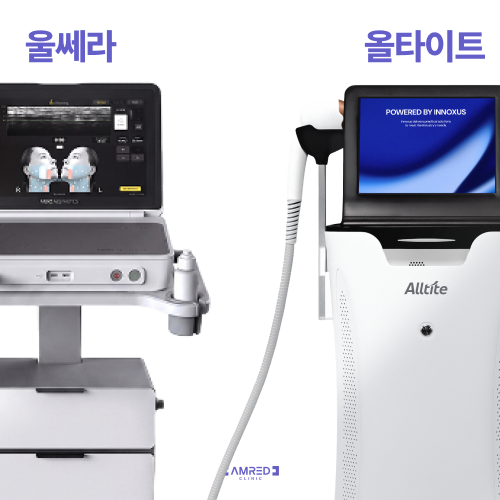
Ultherapy Prime delivers micro-focused ultrasound to the target tissue depth and features the ability to visualize the tissue with ultrasound during the procedure. AllTITE uses radiofrequency-based equipment to deliver energy, and the method and dedicated application areas differ.
Rather than just memorizing the names of ultrasound and radiofrequency, it is practical to check what tissues are being considered during the actual consultation. For example, whether to target a specific area or approach based on the skin's elasticity can change the explanation.
Ultherapy Prime has a ultrasound imaging feature to check subcutaneous tissue during the procedure, while AllTITE uses a dedicated applicator for delivering radiofrequency. Therefore, the former's important explanatory elements are the target depth and tissue imaging, while the latter's are how to consider the handpiece characteristics and skin response. This is why one should not judge safety or superiority based solely on definitive phrases like 'goes to SMAS' or 'does not touch fat.'
When comparing the indications or treatment depths of each device, it is essential to verify whether the information aligns with the manufacturer's guidance and domestic usage conditions. It is difficult to determine superiority with a simple statement like 'the deeper it goes, the better the lifting.'
While it is known that different energies are used, this does not inherently mean that one procedure is more effective than another. The intended use and approval scope of each device should also be checked.
What Should You Look at First When Your Face Looks Saggy?
The reason for a blurred jawline could be due to decreased skin elasticity, the distribution of fat under the chin, or changes in boundaries due to volume loss, which can lead to different approaches.
For instance, in a face with less volume, it is essential to assess whether there are concerns about hollowness after the procedure rather than just expecting strong contour improvement. Additionally, if the front cheek appears hollow but the jawline is blurred, simply asking 'Do I need to pull the whole face tighter?' is not sufficient. It is necessary to explain how to consider the areas with reduced volume and decreased elasticity.
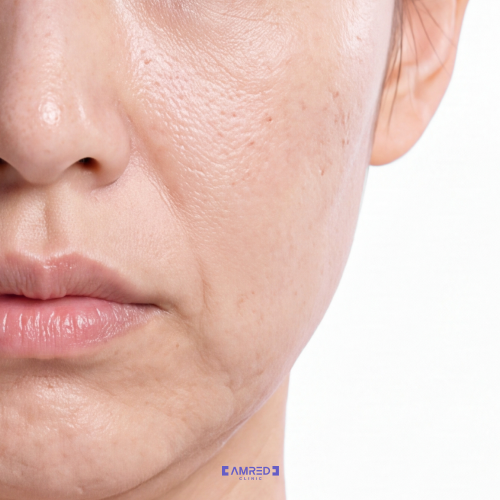
Let's consider a case where the front cheek is relatively hollow and the jawline is blurred. It is crucial to maintain the remaining volume in the front cheek, but the condition of the sagging tissue in the jawline needs to be examined. This raises questions about whether applying the same depth and energy across the entire face is appropriate. Additionally, if the area under the chin is thick, the choice of device may differ depending on whether fat is the main factor or if skin looseness is more significant.
Conversely, if someone has recently gained weight and their chin has become thicker, different judgments may be necessary. It is important not to try to solve one visible symptom with the same machine for everyone.
Describing people as two groups, such as 'Ultherapy for sagging and AllTITE for thin skin,' does not adequately reflect the complexity of actual facial conditions.
How Do Pain and Recovery Differ?
The sensations of heat, tightness, and tenderness experienced during the procedure can vary depending on the energy method, area, and individual sensitivity. No single device can be described as painless or free of side effects for everyone.
If you have an important schedule, you may be curious not only about the pain itself but also about the possibility of redness or swelling on the face immediately after the procedure. It is advisable to receive guidance based on your skin condition and the scope of application rather than determining recovery time solely by the equipment name.
Recovery burden cannot be compared solely based on treatment intensity. Some individuals may be sensitive to the momentary heat of radiofrequency, while others may find the deep tenderness when ultrasound energy is delivered uncomfortable. Considering whether the skin may temporarily redden or swell, how much time to allow if there is a schedule, and whether there have been uncomfortable reactions to previous anesthesia or lifting can provide a more practical comparison than just looking at the price tag.
If you have sensitive skin or have experienced significant discomfort from previous energy treatments, please inform us in advance. This can be helpful when reviewing the anesthesia method and treatment plan.
Since temporary redness or swelling may occur after the procedure, it is advisable to check the expected reactions and precautions in advance. Especially if there is an important schedule, the possibility of recovery after the procedure should also be considered.
Do You Have to Choose Only One?
While there are cases where both devices are considered together, simply using more types does not guarantee better results. It is essential to review whether the application scopes overlap, what each is expected to do, and consider treatment intervals and costs.
Having consulted about both procedures does not necessarily mean that both must be performed concurrently. If the core concern is one, it may be sufficient to prioritize one approach, and if the conditions of multiple areas differ, separate treatments can be discussed.
For example, just because both skin elasticity and jawline sagging are concerns does not mean that both devices need to be used together. First, clarify what changes are expected from one treatment, and then consider combinations when different objectives actually exist. If energy-based treatments are applied to the same area, the order, intervals, and overlapping thermal stimulation should be examined, so one should not decide to combine them based solely on the explanation that 'it's more efficient because it's a package.'
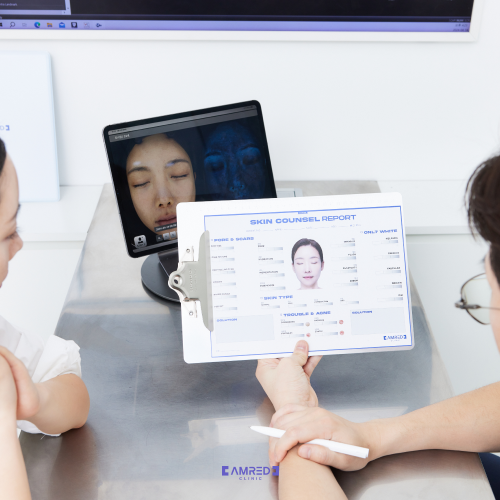
At this time, the reason for adding each should be clear. Rather than the word 'synergy,' check what changes are needed in which areas, and how costs and recovery processes differ.
Especially within the same face, the conditions of the cheeks, jawline, and around the eyes may differ, so area-specific judgments through consultation are necessary.
Selection Criteria from the Perspective of AMRED 4D
AMRED emphasizes a 4D approach that considers not only visible sagging but also the density of skin layers, details of facial contours, and overall harmony. It is meaningful to review what changes are needed from the current state rather than deciding on a specific device first.
In AMRED's 4D, DENSITY and DESIGN can be seen as actively reflecting these aspects. It distinguishes the density and volume state of tissues while observing the overall balance of facial contours.
Therefore, AMRED focuses on explaining which areas and methods are intended to be applied rather than the superiority of devices, and whether the reasons align with the current state of the face. When comparing the two procedures, it is better to check the answer to 'Why apply this device to this area?' rather than the intensity of the energy.
4D is a self-defined perspective of aging analysis and treatment design by AMRED, and does not refer to an independent medical diagnostic classification or a single treatment name.
Actual treatment plans may vary based on the medical staff's diagnosis and individual conditions.