
AMRED Clinic | When Should You Consider Combining Tune Face and Sculptra for Concerns About Hollow Cheeks?
2026-10-28
Contents
If Your Cheeks Appear Hollow, Is Lifting Suitable?
If you want to define your facial contours but your side or front cheeks already look sunken, choosing a treatment can be difficult.
‘Hollow cheeks’ can arise from various causes, including loss of skin elasticity, reduction in fat and soft tissue volume, and the relationship with facial skeletal structure.
Just because hollow cheeks are visible does not mean you should immediately think of volume injections. The situation differs when the volume of the front cheek has decreased versus when surrounding tissues have sagged, making the boundaries appear deeper. Instead of only looking at the result of one part of the face being hollowed out, you should also examine the three-dimensionality of the front cheeks, side cheeks, and the changes in facial contours to clarify the treatment objectives.
Therefore, it is essential to distinguish whether the issue can be resolved solely with elasticity treatments or if a separate approach to volume is necessary.
What Are the Different Roles of Tune Face and Sculptra?
Sculptra is an injectable treatment that uses PLLA components and can be considered for volume-related concerns, while Tune Face is an energy-based equipment program. The two treatments differ in their application methods and goals.
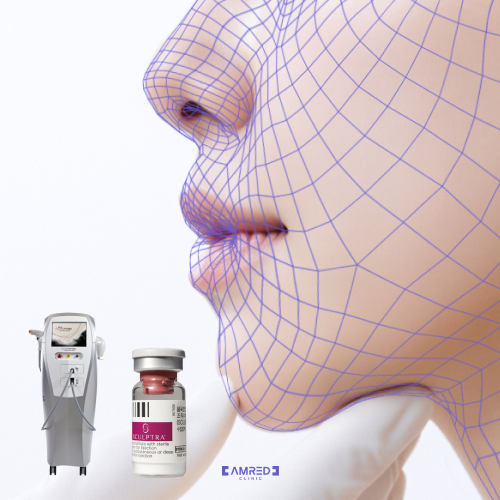
Sculptra is a collagen-stimulating injection that uses PLLA components, which differs from the method of hyaluronic acid fillers that achieve the desired shape immediately upon injection. It is important to differentiate the process of effect manifestation, individual variations, and precautions based on the injection site. In particular, you must fully understand the related risks such as nodules or lumps and confirm the appropriate indications and treatment plan.
Tune Face is a skin and contour management program based on energy, while Sculptra is an injectable product from the PLLA series. The method of delivering energy to the tissue and the approach of expecting changes through product injection differ in the expected areas and outcomes.
Just because the two treatments are mentioned together does not mean their effects automatically add up. For example, if volume loss is the primary concern, repeatedly performing elasticity treatments may lead to results that differ from the desired impression, and the opposite is also true.
It is not necessary to manage the areas where the front cheeks appear sunken and the jawline appears sagging with the same goal. While skin elasticity and insufficient volume may appear together, they require different approaches, so it is crucial to distinguish the roles of the two treatments by area.
How Should We Approach When Both Volume and Elasticity Decline Are Present?
When both volume loss and skin elasticity decline are assessed to be present, different approaches can be considered. However, this does not mean that combination treatments are suitable for everyone or superior to single treatments.
Tune Face is introduced as a skin elasticity treatment utilizing the high-frequency function of the Accent Prime platform. Therefore, while Sculptra primarily addresses volume and collagen stimulation, Tune Face connects to the different goal of skin elasticity. Just because the names of the two treatments are combined does not mean that volume and elasticity will necessarily improve simultaneously. It is essential to separately assess what area requires what purpose.
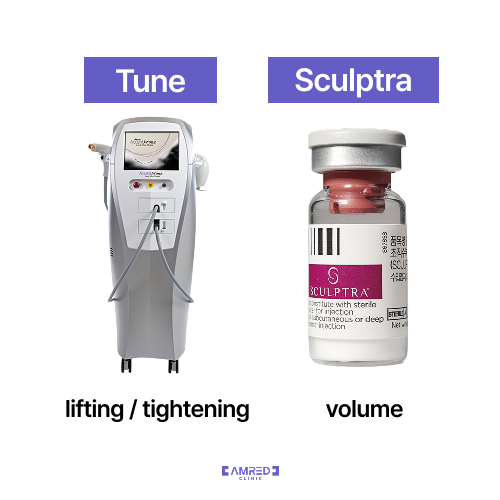
If both volume deficiency and skin elasticity decline are present, it is important to distinguish where each problem occurs. For example, a plan to compensate for the hollowness of the front cheeks and a plan to manage the skin elasticity of the jawline do not imply the same treatment for the same area.
Especially if the face is already at risk of hollow cheeks, careful consideration of the location and range of energy application is necessary. The goal is not the combination itself but rather distinguishing what changes are needed.
A plan that includes the products used, dosage, areas of energy application, and treatment intervals is necessary, so individual consultations should take precedence.
What Should Be Noted in Sculptra Treatments?
In injectable treatments like Sculptra, there are concerns about bruising, swelling, and other adverse reactions such as nodules. It is essential to verify the intended use, injection site, product approvals, and precautions.
For instance, if someone has hollow front cheeks but relatively firm cheek skin, they may question whether Sculptra and high-frequency treatment are necessarily required. Conversely, if the skin appears loose while also experiencing volume loss, the two issues can be separately evaluated. When combining treatments, it is important to check the order of application, intervals, and previous injection treatment history, and results cannot simply be added together.
Avoid making claims that using a specific area will necessarily resolve hollowness or that there are no side effects.
Why Is the Overall Balance of the Face Important When Considering Hollow Cheeks?
When adding volume to the side cheeks, it is important to consider how this will change the impression of the jawline and midface. The goal is not merely to increase volume but to assess based on the desired balance of the face.
In injectable treatments, in addition to temporary reactions such as swelling and bruising, various potential side effects such as infections and nodules should be considered. If energy-based treatments are combined, the reactions occurring in the tissue may overlap, so the intervals between treatments and the appropriateness of the application areas should be examined. If fillers or other collagen-stimulating injections have been received previously, it is important to share the product names and timing of the treatments.
To understand what the desired appearance is, it is necessary to look at each area separately while also examining how they connect across the entire face. The treatment goals are specified based on whether the aim is to change the three-dimensionality of certain areas or the overall impression of the face, rather than just the amount of injection.
How Does AMRED Examine Hollow Cheeks and Elasticity Together?
When cheeks are hollow and the facial contours appear sagging, it is important to distinguish between the areas that need to be supplemented with volume and those that need to be managed for elasticity. Emphasizing only the reduction of contours in a face with prominent hollow cheeks may lead to a different desired impression.
AMRED examines tissue density and volume, detailed sagging, and the overall balance of the face through a 4D aging resolution. For example, if the lack of volume in the front cheeks is the primary concern, the starting point for the treatment plan will differ compared to when skin looseness is the main issue.
Even when considering elasticity management through Tune Face and volume-related approaches through Sculptra, the purposes and application areas must be clear. AMRED focuses on distinguishing the direction of necessary changes in the face rather than simply adding treatments together.
4D is a proprietary aging analysis and treatment design perspective defined by AMRED and does not refer to an independent medical diagnostic classification or a single treatment name.
Actual treatment plans may vary based on the medical staff's assessment and individual conditions.
For booking inquiries, please contact us on WhatsApp.