
Cheongdam Dermatology | What is AMRED 4D? The Reason for Viewing Aging from Four Perspectives
2026-10-20
Contents
The Reason Different Approaches are Needed for Similar Skin Concerns
As we age, we experience changes such as fine lines around the eyes, sunken cheeks, and a less defined jawline.
At this point, many people start to think about which lifting procedure to undergo and which equipment would be suitable for their concerns.
However, even if the signs of aging appear similar on the surface, the underlying causes can be quite different.
For instance, the appearance of deeper nasolabial folds may result not only from changes in skin elasticity but also from a decrease in cheek volume,
shifts in fat tissue positioning, and changes in surrounding support structures, among other factors.
Visible wrinkles or sagging are the results, and what we really need to examine are the causes and depths that led to these changes.
Why Did AMRED Introduce 4D?
AMRED's concept of personalized anti-aging does not start with choosing one of several procedures.
It begins with identifying what changes are currently present on the face, how deep those changes are related,
and what management is needed now and in the future.
This systematic approach is what AMRED's 4D Anti-Aging Resolution is based on.
4D does not refer to a new lifting procedure or specific equipment. It is a unique clinical perspective established by AMRED to understand the aging patterns of the face more three-dimensionally and
to explain individualized treatment directions.
If the causes and depths of aging differ, then the methods and order of management can also vary.
Therefore, the purpose of 4D is not simply to analyze more or to perform more procedures.
It is about distinguishing between the changes that are currently necessary and those that are not, in order to set personalized management directions.
Examining the Four Depths of the Skin Together.
Aging of the face does not occur in just one layer.
Changes can manifest at different depths, from surface skin changes to density and volume within the skin,
and changes in the structures that support the face.
To understand these changes, AMRED examines the four depths of the epidermis, dermis, fat, and SMAS,
and considers relationships with deeper support structures as needed.
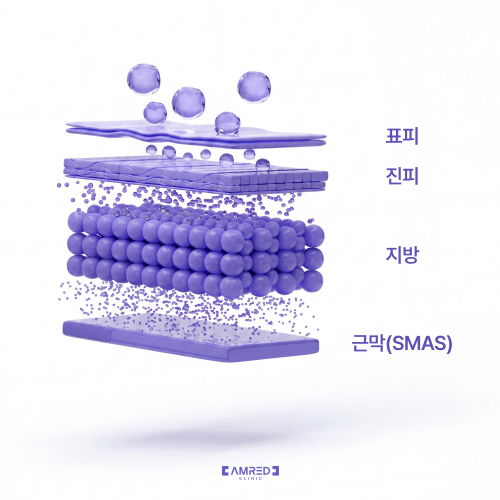
In the epidermis, we observe changes in skin texture and moisture levels,
while in the dermis, we look at changes affecting skin density and elasticity.
In the fat layer, we consider volume loss or positional changes, and in the fascia and surrounding support structures,
we take into account elements that contribute to facial sagging and shape changes.
Importantly, we do not evaluate these four depths independently.
Since multiple layers can be involved in a single aging phenomenon,
it is necessary to understand not only the state of each layer but also the relationships between the layers.
Four Perspectives for Interpreting the Four Depths
AMRED's 4D serves as a standard for examining the four depths of the skin from four perspectives.
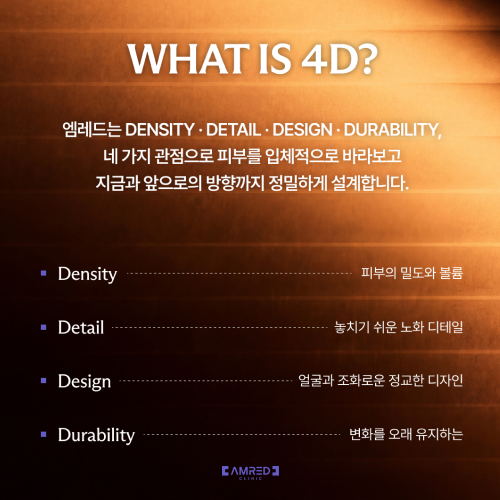
01. DENSITY — Density and Volume
We examine changes in skin density and facial volume. If the skin appears thin or volume has decreased,
it may be necessary to consider the state of density and volume first, rather than simply pulling.
02. DETAIL — Details of Aging
We look at detailed changes in areas where the skin is thin and highly mobile, like around the eyes.
Even the same fine lines may require different approaches depending on whether they are related to changes in skin condition or repetitive facial movements.
03. DESIGN — Harmony and Design of the Face
We consider the proportions and contours of the face, as well as the positioning and direction of soft tissue sagging.
It is important not only how strongly we pull but also which areas we approach and in what direction.
04. DURABILITY — Maintenance and Management of Changes
We consider the structures that support the face and changes over time.
Rather than focusing solely on immediate external changes, we set management directions by considering the state of support structures and future developments.
These four perspectives do not correspond to just one skin layer or procedure.
For a single concern, multiple perspectives may be needed simultaneously, and
integrating these to understand individual conditions is the core of AMRED 4D.
What Matters is How We Interpret the Analysis Results.
AMRED utilizes the AI 3D skin analysis device EVE V to examine skin conditions and facial shapes.
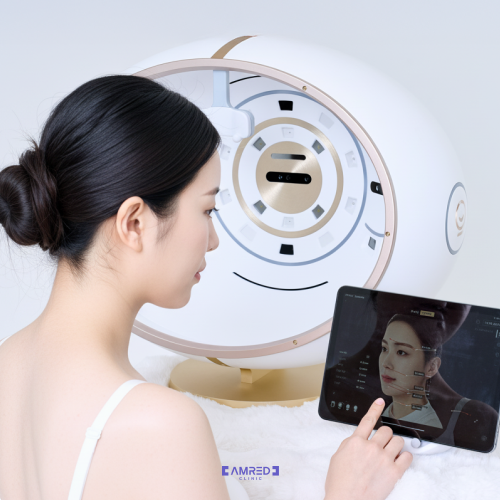
This analysis data serves as a reference for understanding the current state, in addition to what can be observed visually.
However, the results from the analysis equipment do not definitively determine all causes of aging or dictate procedures.
In actual consultations, it is essential to consider the individual's perceived concerns, the condition of their skin and face, previous treatment history, management goals,
and the medical staff's clinical opinions.
For example, even if someone is concerned about sagging jawlines, if changes in skin elasticity are prominent compared to shifts in soft tissue positioning,
the types of procedures, application areas, and order of treatment may differ.
Additionally, it is just as important to distinguish what procedures are necessary now as it is to identify management that does not need to be performed at this moment.
AMRED's 4D is an approach to explain these judgments using a common standard of four perspectives and four depths.
If the resolution is different, the solutions are different.
If the Resolution is Different, the Solutions are Different.
In anti-aging, what matters is not how many procedures you choose, but understanding what changes are occurring in your own face.
AMRED aims to explore the causes and depths behind visible concerns,
and based on this, distinguish between current necessary management and future management directions.
To understand the same face in greater detail and reflect those differences in treatment design.
This is why AMRED has introduced the standard of 4D.
4D. SEE THE DIFFERENCE.
If the resolution is different, the solutions are different.
4D is AMRED's own defined perspective for aging analysis and treatment design,
and does not refer to independent medical diagnostic classifications or single procedure names.
Actual treatment plans may vary based on the medical staff's consultations and individual conditions.