
Cheongdam Dermatology | What are the differences between 1 session and 4 sessions of Emface?
2026-10-29
Contents
What are the differences between 1 session and 4 sessions of Emface?
Emface is generally recommended as a lifting treatment that involves multiple sessions, and when considering the treatment, one may ponder the effects and costs associated with the number of sessions. You might wonder if sufficient changes can be expected from just one session, and what the reasons are for proceeding with four sessions.
Emface is a treatment that simultaneously utilizes radiofrequency (RF) and high-intensity facial muscle stimulation (HIFES) technology to act on the skin and facial muscles. Unlike typical radiofrequency lifting that delivers thermal energy to the skin, it has the characteristic of considering the movement and tension of facial muscles as well.
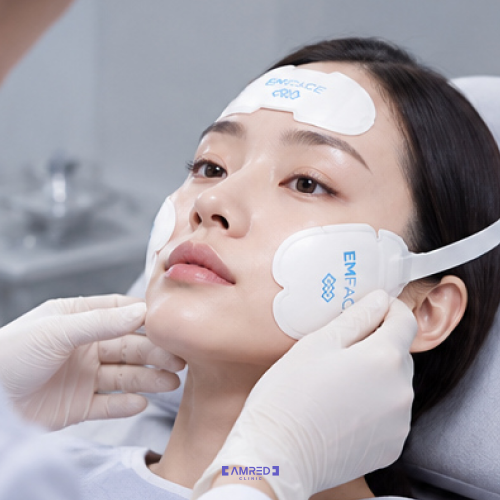
A single session applies this energy once, while a four-session program is structured to induce changes in the skin and muscles by repeating stimulation at regular intervals.
In fact, major clinical studies on Emface evaluate changes in wrinkles and facial appearance after four sessions conducted at approximately one-week intervals. Therefore, four sessions are not merely an increase in the number of treatments, but a representative treatment protocol that considers the action characteristics of Emface.
However, this does not mean that four sessions will yield exactly four times the effect of one session. Changes due to the number of sessions can be influenced by the condition of the skin and muscles, as well as individual responses.
How does Emface act on the skin and muscles?
The characteristic of Emface is that the radiofrequency energy related to skin elasticity and the HIFES technology stimulating facial muscles act simultaneously.
First, radiofrequency (RF) delivers thermal energy to the skin and surrounding tissues, inducing changes in collagen, elastin, and other elasticity-related tissues. This process is utilized to improve skin elasticity and fine wrinkles.
HIFES is a technology that induces contraction of facial muscles through high-intensity electrical stimulation. It particularly stimulates the muscles around the forehead and cheeks, affecting muscle tension and function, allowing for management of both the skin and facial muscles.
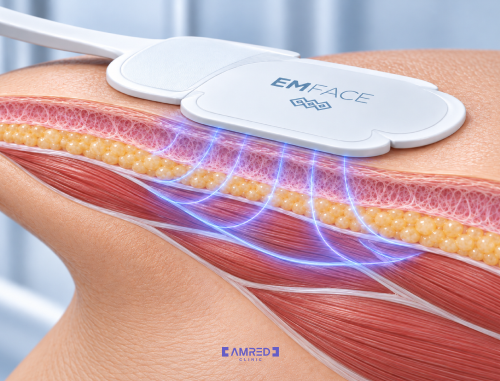
These two types of energy are applied simultaneously in a single treatment process. When both skin elasticity degradation and changes in facial muscles occur, it differs from typical heat-based lifting in that it utilizes energy acting on different tissues.
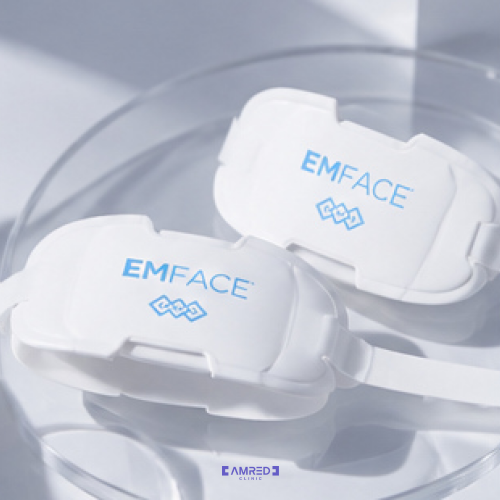
Additionally, Emface is performed by attaching a dedicated applicator to the skin without incisions or injections. During the treatment, one may feel warmth in the skin along with a sensation of repeated contractions in the facial muscles.
Since Emface acts on the skin and muscles in different ways, it is a lifting treatment that considers not only the sensations immediately after the procedure but also the changes in tissues that occur after repeated stimulation.
Can you feel changes with just one session of Emface?
Emface delivers radiofrequency and HIFES energy to the skin and facial muscles even in a single session. Therefore, one session does have an effect, but it is important to distinguish between the immediate changes felt after the treatment and the long-term improvement effects.
During the treatment, one may experience a warm sensation from the radiofrequency along with a feeling of tension or repeated movement in the muscles around the forehead or cheeks. After the treatment, one might temporarily feel that the skin has tightened or that the face feels lifted.
However, this sensation does not necessarily mean that sufficient collagen remodeling or changes in muscle condition have occurred. Changes in tissues related to collagen and muscles cannot be evaluated solely based on the sensations immediately after the treatment, and it is necessary to observe the progress over time.
In particular, most major clinical studies evaluating the effects of Emface have observed changes after completing four sessions. Therefore, it is difficult to expect the same level of change from just one session as from a four-session program.
While energy does act on the skin and muscles during one session, clinically confirmed changes are primarily understood based on programs involving multiple sessions. However, since individual differences exist, it is important to design the appropriate number of sessions after diagnosis and to observe and apply them periodically.
What changes can be expected after four sessions of Emface?
In major clinical studies on Emface, changes in wrinkles and facial appearance were observed over a certain period after conducting four sessions at approximately one-week intervals.
A multicenter clinical study published in 2025 evaluated the progress of 33 participants who underwent four sessions of Emface, assessing the results one month and three months after the treatment.
According to 3D imaging analysis, the wrinkle assessment index measured in the study showed an average improvement of about 20.1% immediately after the treatment and an average improvement of about 35.4% three months after the last session. These results pertain to the participants in the study, and individual improvement levels may vary.
Notably, the wrinkle improvement index was higher three months after completing the four sessions than immediately after.
Emface utilizes both the thermal response of the skin from radiofrequency and muscle stimulation from HIFES. While the sensation of muscle contraction can be felt immediately during the treatment, changes in the skin and tissues may appear over time.
Therefore, Emface is a lifting treatment that considers not only the immediate results after completing four sessions but also the subsequent changes in wrinkles and elasticity.
Is maintenance necessary after four sessions of Emface?
Emface is generally conducted as a basic program of four sessions, but completing this does not mean that changes in the skin and facial muscles will remain in the same state indefinitely.
In major clinical studies on Emface, changes such as wrinkle improvement were observed for a certain period even after completing four sessions. However, these results do not necessarily maintain the same duration for everyone, and there may be differences depending on individual skin conditions and the progression of aging.
For example, even if one feels improvements in skin elasticity and wrinkles after completing four sessions, the natural aging process continues over time. Therefore, additional maintenance may be considered based on the changes in the areas initially targeted for improvement and the current skin condition.
Maintenance does not necessarily have to be conducted by repeating the same four-session program. Depending on the changes observed after previous treatments and the maintenance state, one may consider additional Emface sessions or explore other energy-based lifting options.
Especially in cases where not only skin elasticity but also volume loss or sagging of deeper tissues occurs, different treatments can be combined to address various aging concerns.
Emface induces changes in the skin and muscles through the basic four-session program, and thereafter, maintenance and additional treatments can be planned based on individual progress.
How does AMRED determine the number of Emface sessions?
AMRED examines changes in skin elasticity and facial muscles during Emface treatments and plans treatment directions suitable for individual aging patterns.
For instance, if the elasticity of the cheeks is declining and the facial contour appears sagging, the necessary approach may differ depending on whether the primary issue is the loss of skin elasticity or changes in facial muscles.
Additionally, if the volume of the front cheeks has decreased, making the midface appear flat, it may be difficult to achieve the desired changes with just skin and muscle elasticity management. Consideration must also be given to the three-dimensionality and volume distribution of the face.
To distinguish these differences, AMRED utilizes a 4D aging resolution that considers four depths and densities (DENSITY), details (DETAIL), design (DESIGN), and durability (DURABILITY) as the basis for treatment planning.
Based on this, the condition of the skin and muscles is assessed, and the necessity and improvement goals for Emface are reviewed. If Emface is deemed appropriate, a plan is established based on the general four-session treatment protocol, considering the individual's health status, skin response, and treatment objectives.
After the treatment, the progress is monitored, focusing on the skin elasticity and facial changes that were initially targeted for improvement, and if necessary, maintenance or the possibility of combining with other lifting treatments can be reviewed.
AMRED's 4D Emface focuses on assessing the necessity of treatment by considering changes in the skin and facial muscles, and designing lifting plans tailored to individual conditions.
4D is a proprietary aging analysis and treatment design perspective defined by AMRED and does not refer to an independent medical diagnostic classification or a single treatment name.
Actual treatment plans may vary based on the medical staff's diagnosis and individual conditions.