
Cheongdam XERF | XERF Cycle, How Long Should the Interval Be? Skin Reactions Over Time and Treatment Cycle
2026-11-11
Contents
What is the reason for the immediate effects after XERF treatment?
After receiving the XERF treatment, some people feel changes such as a more defined jawline and firmer skin right away.
"So, is the change that appears immediately after the treatment the final effect?"
XERF is a lifting treatment that delivers high-frequency energy to the skin tissue to induce a thermal reaction. During the process of delivering thermal energy, the existing collagen may contract, leading to a feeling of tightness or changes in contour immediately after the treatment.
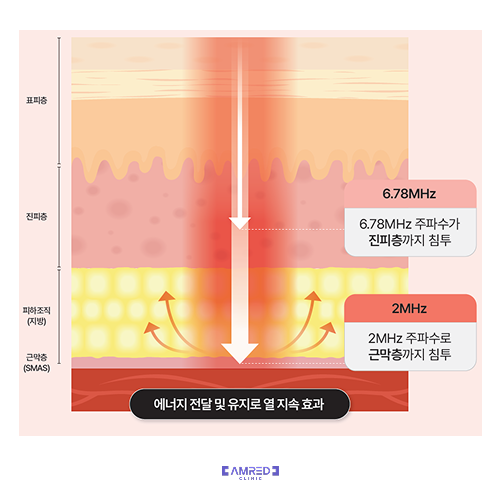
However, immediate swelling and other temporary changes can also affect the appearance. Therefore, it is difficult to conclude that the treatment effect is complete based solely on the initial changes observed in the mirror.
The important thing is that the changes in the skin after XERF treatment do not end at a single point in time but can continue over a certain period.
Why does it feel like the effect diminishes 2-4 weeks after XERF treatment?
If the jawline that was satisfying right after the treatment seems similar to before as time passes, you may worry that the effect has disappeared.
Especially around 2-4 weeks after the treatment, the initial swelling subsides, and the appearance may feel different from immediately after. Initially, the face seemed more refined, but over time, that change may appear to lessen.
However, it cannot be concluded that the lifting effect has disappeared based solely on these visual changes.
The skin tissue that received high-frequency thermal energy continues to undergo recovery and regeneration processes after the treatment. Changes in collagen and other skin tissues take time, so it is better to observe the progress rather than make a final judgment based on the initial appearance.
Therefore, even if you feel that the effect is lacking during this period, it is important to check the skin condition and the process of change rather than immediately deciding on additional treatment.
How will the effect change 2-3 months after XERF treatment?
What to look for as time passes after XERF treatment is the collagen regeneration process occurring within the skin.
After high-frequency thermal stimulation, the recovery response of the skin tissue continues, and this process may involve the activity of fibroblasts and the formation of new collagen.
Collagen plays a crucial role in maintaining the elasticity and structure of the skin. Therefore, as the regeneration process progresses, the skin may gradually become firmer, and changes may be felt in fine lines, skin texture, and contours.
Unlike the changes observed immediately after the treatment, the changes that appear over time are related to the internal regeneration process of the skin.

However, not everyone experiences the same degree of change at the same time. The timing and extent of changes may vary depending on skin condition, degree of aging, treatment scope, and application conditions.
Therefore, after XERF treatment, it is advisable to observe skin changes over a certain period rather than making judgments based solely on the immediate appearance.
Can I receive a re-treatment of XERF after 1-2 months?
If you have experienced satisfactory changes after XERF treatment, you may want to receive treatment again at a short interval to maintain the effects longer.
However, rushing into additional treatment before the effects of the previous treatment have fully manifested should be approached with caution.
As mentioned earlier, after XERF treatment, not only the initial thermal response but also the recovery and regeneration processes of the skin tissue can continue. Therefore, rather than simply judging that the effect is lacking just because 1-2 months have passed since the treatment, it is better to first check the current skin condition.
So, what is an appropriate cycle for XERF?
Generally, when considering the timing for re-treatment, a gap of about 6 months to 1 year can be referenced, but it is difficult to apply this as a standard for everyone.
The appropriate timing may vary depending on the scope and energy conditions applied in the previous treatment, the current skin elasticity and sagging degree, and the progress after the treatment.
Therefore, rather than simply repeating at short intervals, it is important to thoroughly observe the changes from the previous treatment and confirm whether additional treatment is necessary.
What does AMRED consider for the XERF cycle?
AMRED believes that determining the XERF treatment cycle should not be based solely on the date of the last treatment.
Even if treatments were received at the same time, the current condition may vary based on skin elasticity, sagging degree, the scope of the previous treatment, and individual responses. Therefore, it is important to examine the current skin condition along with the history of previous treatments.
This process reflects AMRED's 4D aging resolution perspective. It considers the density and elasticity of skin tissue (DENSITY), detailed changes such as fine lines and skin texture (DETAIL), overall facial balance (DESIGN), and changes and durability after treatment (DURABILITY).
Based on this, we check how the changes immediately after the treatment are being maintained, what changes in elasticity and contour appear over time, and whether it is the right time for additional treatment. If changes from the previous treatment are still ongoing, it may be more appropriate to observe the progress rather than rush into re-treatment.
The XERF cycle is not a number that applies equally to everyone. Rather than repeating at fixed intervals, it is important to determine the appropriate treatment timing based on the current skin condition and the progress of previous treatments. At AMRED, we examine the timing for re-treatment through consultations that consider individual skin conditions and management goals.
4D is a proprietary perspective on aging analysis and treatment design defined by AMRED, and does not refer to an independent medical diagnostic classification or a single treatment name.
Actual treatment plans may vary based on the medical staff's diagnosis and individual conditions.