
Cheongdam Dermatology | Is the Management Different if the Causes of Double Chin and Jawline Sagging are Different?
2026-10-22
Contents
Are Double Chin and Jawline Sagging the Same Concern?
Just because the area under the chin looks thick and the jawline appears blurred in a photo, it doesn't mean they have the same cause. Factors such as the amount of submental fat, skin elasticity, the shape of the chin, posture, and the distribution of soft tissues can all affect the appearance.
Have you ever thought, 'I developed a double chin because I gained weight,' but experienced little to no change in weight? Even when the area under the chin appears fuller, factors such as skin sagging and changes in the boundary between the face and neck can also play a role.
A double chin can appear simply due to excess fat, but it can also be more pronounced if the shape of the chin is short or if the angle between the neck and chin is obtuse. Additionally, if the skin on the lower part of the face becomes loose, the same amount of fat can lead to a blurred boundary. Although the result may show a double chin in the photo, it is essential to examine the amount of fat, the arrangement of the skeleton and soft tissues, and the elasticity of the skin.
Even if it is the same double chin, the details to check will differ depending on whether it folds only when you lower your head, whether the jawline is blurred from the front, or whether it is more pronounced in profile.
Therefore, even if it is an area referred to as a double chin, it is crucial to first distinguish which structural elements are primarily at play.
When There Appears to Be Excess Volume Under the Chin
If the fat under the chin is relatively prominent, it can appear as a double chin regardless of weight changes.
However, the visible thickness does not solely indicate fat, so the shape of the chin and the condition of the skin should also be examined.
Even if you feel volume when you touch under the chin, that alone cannot accurately determine the amount of subcutaneous fat. Weight changes and face shape should also be considered.
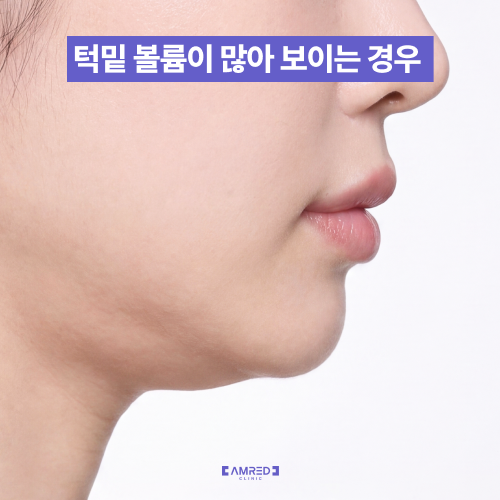
If you feel that the area under your chin has become fuller without weight gain, compare it with past photos to check the angle and posture in which they were taken. Even a slight difference in the angle at which you lower your head can cause the skin under the chin to fold, making it appear thicker. Conversely, if the volume under the chin is distinct even when you are expressionless and there is a lot of tissue that can be pinched, it may be difficult to explain solely by skin elasticity. In such cases, it is essential to distinguish the purpose of management targeting energy devices and fat.
Particularly, depending on the shape of the chin and the angle leading to the neck, even if the amount of fat is similar, it can appear differently in photos. In such cases, it is necessary to understand the facial structure separately from the simple approach of 'losing weight.'
In these cases, simply performing a procedure to pull the skin up may not achieve the desired change. It is advisable to compare the purpose and suitability of procedures for each area.
When Skin Elasticity Decline is Central
If the weight is similar but the boundary of the jawline is blurred, changes in skin and soft tissue elasticity should also be considered. However, just because there is a decline in elasticity does not mean that all lifting devices work in the same way.
On the other hand, if the area under the chin feels more like loose skin folding rather than fullness, it may be helpful to first examine the decline in elasticity. Observing whether the skin around the mouth and jawline has also changed can be a useful point of observation.
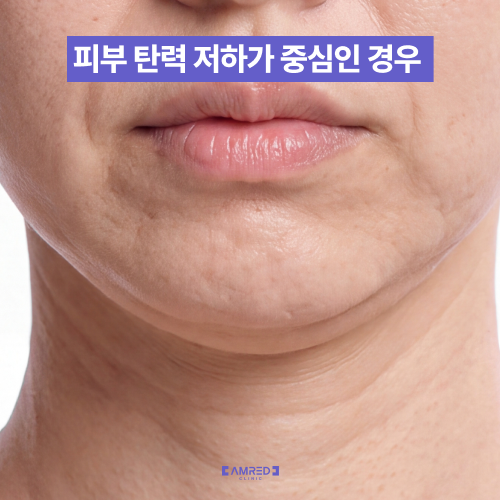
When the skin is loose, the boundary of the jawline may appear more blurred when looking down than when looking up, or the tissue under the chin may appear to sag downwards. Devices that manage skin elasticity can consider these issues, but if the amount of fat itself is the main cause, the expected changes may be limited. Even for the same 'jawline lifting,' it is important to confirm what tissue is being targeted.
However, just because the skin appears momentarily clearer when pulled by hand does not mean that the results of a specific lifting procedure can be predicted. The actual goals of the procedure should be clarified through consultation.
During the consultation, explain which direction the changes in facial lines are most pronounced and whether they appear alongside volume loss in other areas.
How Do Ultherapy, Onda, and Other Procedures Differ?
Ultherapy, which uses micro-focused ultrasound, and Onda, which utilizes microwave technology, differ in energy methods and treatment goals. To determine which procedure is suitable for a double chin, it is necessary to assess whether the issue is related to fat reduction or if skin elasticity management is a priority.
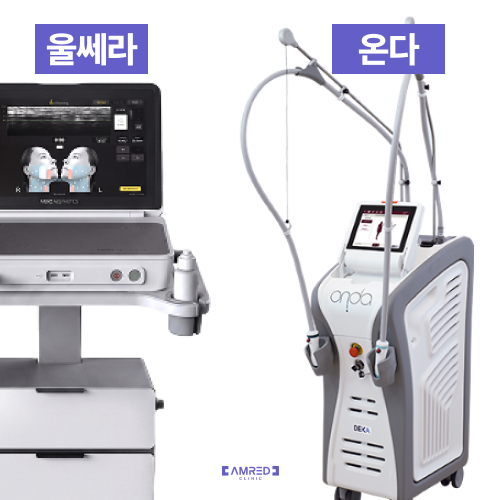
Onda uses microwave, while Ultherapy employs focused ultrasound as its approach.
Although the energy methods are different, it does not mean that a specific procedure is necessarily effective for a particular person's double chin.
If the chin is short or the contour of the lower jaw is recessed, the jawline may appear dull even with little tissue volume. In such cases, if only fat reduction is considered, the originally lacking three-dimensionality may become more pronounced. It is necessary to examine whether the cause of the appearance of excess fat under the chin is actual fat or the relative positioning of the skeleton and tissues.
For example, whether the volume under the chin is the main concern or if the appearance of sagging skin is the primary issue can lead to different discussions regarding the procedures during consultation. It is more rational to clarify 'what needs to be reduced or improved' before comparing devices.
The appearance when lightly lifting the jawline by hand may differ from when lowering the head. Explaining to the medical staff which posture and angle are most concerning can help determine whether it is simply skin sagging or if other factors need to be considered.
Having a long list of devices does not guarantee better results, and it is also important to distinguish areas that do not require treatment.
Questions to Confirm Before Double Chin Treatment
We recommend asking questions such as, 'Is the issue submental fat or sagging skin?', 'What area will be treated?', and 'What changes and limitations can be expected?'
Taking front and side photos with your usual expression before the consultation can make it easier to explain what aspects you want to improve. In particular, convey whether you are only concerned when lowering your head or if it is a concern even when standing naturally.
Even if you see expressions like 'the double chin is gone' in online reviews, it is essential to clarify what changes are being referred to. Whether the angle of the jaw in the photo has changed, if the skin has become firmer, or if the volume under the chin has decreased are different results. When setting goals, breaking down the desired appearance into specifics rather than just the name of one device can help reduce excessive expectations.
If there is a difference between the expected contours and the changes that can realistically be considered, it is crucial to receive explanations in advance. Not all double chins can be eliminated with a single procedure.
It is better to examine whether the description of a guaranteed sharp facial line in a short period is specific regarding the current state and information about side effects and recovery.
What Makes AMRED's Approach to Jawline Different?
Even with the same concern about double chins, the reasons for the appearance of fullness under the chin can vary. It is challenging to resolve cases where fat is relatively distributed, where the supporting strength of the skin around the jawline has weakened, or where the angle between the chin and neck or the facial skeleton emphasizes volume with a single method.
AMRED proposes a 4D approach that distinguishes changes occurring in the skin and fat layers and examines the connection between the jawline and neck. For those who want to reduce volume under the chin, the distribution of fat may be crucial information, while for those who do not have much fat but have a blurred jawline, skin elasticity and shape changes may be more important.
Therefore, when exploring double chin treatments, first check whether 'the thickness under the chin is a concern or if the blurred boundary between the chin and neck is the issue.' The clearer the direction of change needed, the more the criteria for comparing procedures like Ultherapy or Onda will differ.
4D is a proprietary aging analysis and treatment design perspective defined by AMRED and does not refer to an independent medical diagnostic classification or a single treatment name.
Actual treatment plans may vary based on the medical staff's consultation and individual conditions.