
Cheongdam Dermatology | What is Ellansé? Expected Changes and Precautions
2026-10-28
Contents
What is Ellansé?
Ellansé is a collagen-stimulating agent used for facial volume loss and wrinkle improvement. It can help restore lost volume while promoting collagen production within the skin, leading to improvements in facial contours and tissue elasticity.
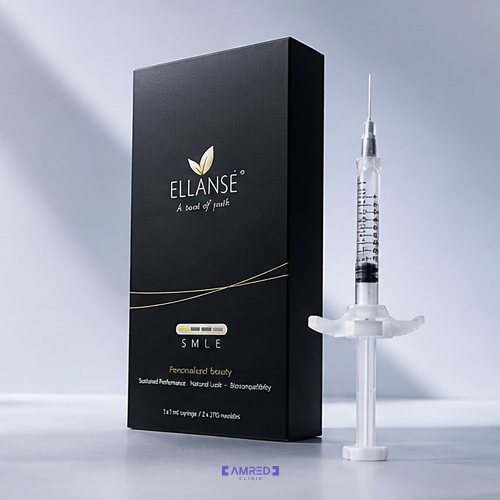
As we age, facial volume loss can make the cheeks or temples appear sunken, or reduce the three-dimensionality of the face. Ellansé is used to improve these volume changes, considering not only the immediate volume restoration after the procedure but also the collagen formation that occurs over time.
It is particularly utilized when facial volume loss and decreased skin elasticity occur simultaneously, as it can compensate for the lack of volume while inducing tissue changes.
How is Ellansé different from hyaluronic acid fillers?
Both Ellansé and hyaluronic acid fillers are used to restore lost facial volume, but they differ in how they create and maintain volume.
Hyaluronic acid fillers directly compensate for tissue volume with the injected hyaluronic acid gel. In contrast, Ellansé consists of PCL (polycaprolactone) microspheres and CMC (carboxymethylcellulose) gel.
The CMC gel in Ellansé forms volume immediately after injection, while the PCL microspheres induce collagen production in the surrounding tissue. Over time, as the CMC gel is gradually absorbed and collagen is formed, changes in volume and tissue occur.
The two procedures also differ in how they adjust the shape after the procedure. Hyaluronic acid fillers can be broken down using an enzyme called hyaluronidase, depending on the product characteristics, but the PCL and CMC components of Ellansé cannot be directly broken down in the same way. Therefore, the initial injection site and volume must be determined more carefully with Ellansé.
Thus, Ellansé differs from hyaluronic acid fillers in that it involves both initial volume formation and subsequent collagen generation.
What does Ellansé focus on: volume or elasticity?
Ellansé is a procedure that restores facial volume while inducing collagen production, particularly considered when volume decreases or facial three-dimensionality diminishes with age.
For example, if the volume of the cheeks decreases, the midface may appear flat, or hollowness under the cheekbones may become prominent. In such cases, it may be necessary to restore volume in the lacking areas to improve facial contours.
Moreover, facial volume loss is not just an issue of the sunken areas. When the volume of the cheeks decreases, the boundaries with surrounding areas may become more pronounced, or the shadows in the nasolabial folds may appear deeper, affecting the overall impression of the face. Therefore, the injection site and range may vary depending on where the volume loss occurs.
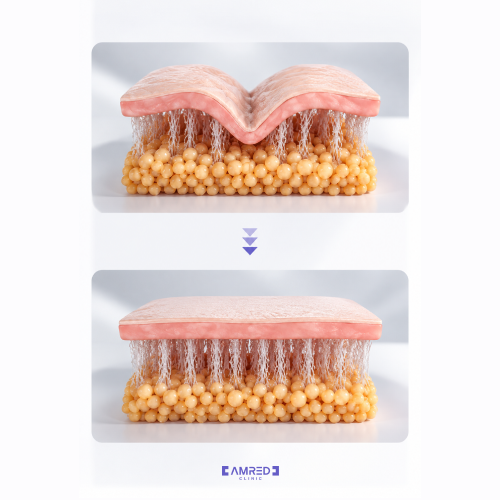
The PCL component of Ellansé induces collagen production, so changes in tissue elasticity and density can be expected over time. However, this does not mean that this characteristic will uniformly improve all skin elasticity loss or sagging.
For instance, if the skin itself has become loose, leading to sagging of the jawline, simply restoring volume may not provide sufficient lifting effects. Conversely, if the face appears sunken or wrinkles look deeper due to volume loss, compensating for the lacking areas may be appropriate.
Ellansé is utilized to improve facial volume loss and the resulting contour changes, and it is a procedure that can also expect changes in tissue due to collagen generation.
How should we understand the effects and duration of Ellansé?
Ellansé is a procedure that needs to consider both the immediate volume changes that appear right after the procedure and the changes due to collagen formation that occur over time.
Immediately after injection, the CMC gel compensates for the volume in the lacking areas, allowing for relatively quick visual changes. As the CMC gel is gradually absorbed, collagen formation progresses due to the action of the PCL microspheres, leading to gradual changes in volume and tissue condition.
Due to these characteristics, the appearance immediately after the procedure and a few months later may not be identical. Initially, the injected gel and swelling from the procedure can affect the appearance, while later, collagen formation and tissue changes will influence the results.
Ellansé is also characterized by a relatively long duration. The duration varies depending on the product type, and Ellansé M is known to have a durability of about 2 years. However, the actual duration may differ based on the product used, injection site, individual tissue response, and degree of aging.
Additionally, a long duration does not mean that the volume immediately after the procedure will maintain the same shape continuously. Over time, as the product components are absorbed and collagen is formed, changes in volume and contours may occur.
Therefore, Ellansé is a procedure that can consider immediate volume restoration, collagen formation over time, and a relatively long duration.
What reactions should we be cautious of after Ellansé treatment?
Since Ellansé involves injecting a product into the skin and tissue, temporary redness, swelling, bruising, and tenderness may occur immediately after the procedure. These reactions generally subside over time, but the recovery process may vary depending on individual skin conditions and injection sites.
In particular, since Ellansé contains PCL, which induces collagen production, it is necessary to monitor tissue reactions that may occur not only immediately after the procedure but also later.
For example, temporary swelling immediately after the procedure and the occurrence of hard lumps or nodules at the injection site after a certain period are different reactions. These changes can arise from various causes, including the distribution of the injected product, tissue reactions, and inflammation, and appropriate medical care may be needed depending on the timing and symptoms.
Also, as with all injection procedures, there is a possibility of complications such as incorrect injection into blood vessels or effects on blood flow. If severe pain, whitening of the skin, or visual disturbances occur during or immediately after the procedure, immediate medical evaluation and treatment are necessary.
Since Ellansé has different components from hyaluronic acid fillers, the response methods when adverse reactions occur also differ. In particular, PCL and CMC cannot be directly broken down by hyaluronidase, so medical care and responses must be tailored to the product's characteristics.
For these reasons, Ellansé should be performed considering the anatomical structure of the injection site, skin condition, and previous treatment history, and it is necessary to monitor the subsequent tissue changes.
How does AMRED design the Ellansé treatment?
AMRED examines not only simply filling the volume of sunken areas but also where the volume loss has occurred on the face and how these changes affect the overall contours.
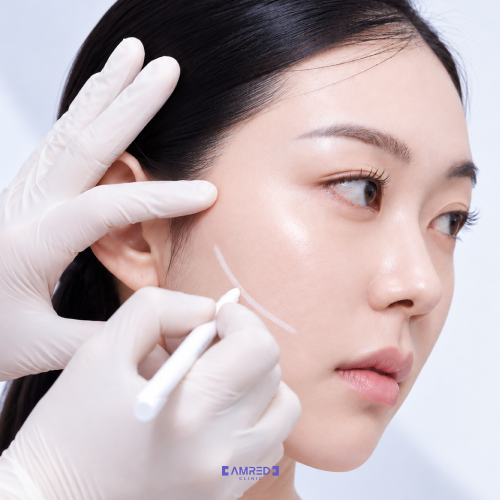
For example, if the volume of the cheeks decreases, making the midface appear flat, and hollowness under the cheekbones becomes prominent, the required volume's location and degree may differ.
Moreover, excessively compensating for the lacking volume may disrupt the balance with surrounding areas. Therefore, it is important to plan the necessary range considering the original facial shape and volume distribution rather than simply increasing the injection amount.
AMRED utilizes a 4D aging resolution as a standard for treatment design to distinguish these differences. We examine the density and volume of the skin and tissue (DENSITY), detailed aging changes (DETAIL), and the overall balance of the face (DESIGN) to review the necessary improvement direction for each individual.
Based on this, we determine the areas needing volume restoration and the injection range, planning the treatment while considering the immediate volume changes and subsequent tissue changes due to collagen production.
Especially since Ellansé may show changes due to collagen formation over time, an approach that considers not only the appearance immediately after the procedure but also the subsequent volume and overall harmony of the face is necessary.
AMRED's 4D Ellansé carefully examines the causes of individual volume loss and the overall balance of the face, complementing the appropriate volume in the necessary areas and designing natural contours.
4D is a proprietary aging analysis and treatment design perspective defined by AMRED and does not refer to an independent medical diagnostic classification or a single treatment name.
Actual treatment plans may vary based on the medical staff's evaluation and individual conditions.