
Cheongdam Dermatology | Why Check the Skin with Ultherapy Ultrasound
2026-11-25
Contents
What Information Does Ultherapy Ultrasound Imaging Show About the Skin?
Ultherapy is a lifting device that uses ultrasound to visualize the tissue beneath the skin in real-time while delivering energy into the skin.
The DeepSEE technology allows for visual examination of the skin layers and the underlying tissue, providing a reference for understanding the internal structure of the treatment area.
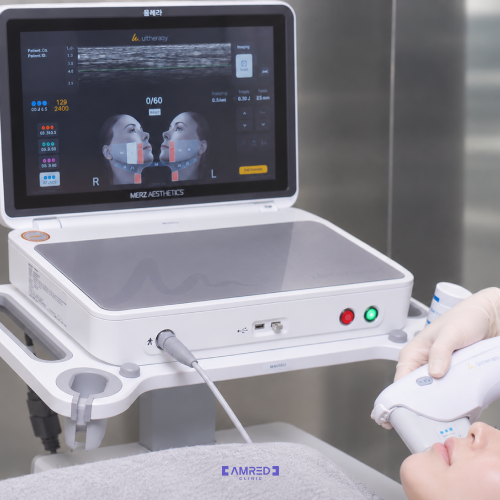
In Ultherapy, ultrasound is utilized for both visualizing the tissue beneath the skin and delivering energy. After examining the position and condition of the tissue through imaging, the location and depth for energy delivery are reviewed.
This verification process is crucial because it can be challenging to accurately determine the position and structure of internal tissues based solely on the skin's surface. Especially on the face, where the shape and depth of tissues vary by area, it is important to incorporate the information obtained from imaging into the treatment plan.
In other words, Ultherapy ultrasound is used not only to show what is beneath the skin but also to understand the structure of the treatment area and review the energy delivery locations.
Why Does the Ultherapy Treatment Plan Vary by Facial Area?
The thickness of the skin, distribution of fat layers, and position of underlying tissues differ across facial areas. The forehead, cheeks, jawline, and under the chin have distinct structural characteristics, making it difficult to establish a uniform treatment plan.
Additionally, the reasons for a dull facial contour can vary from person to person. Factors such as decreased skin elasticity, fat layer distribution, and facial structure can all play a role. Even if the outward appearance seems similar, the actual considerations may differ.
Therefore, when formulating a treatment plan, it is essential to consider not only the areas with noticeable sagging but also the overall shape and volume balance of the face. Distinguishing between areas that need improvement and those that should be maintained for a natural contour is also important.
Examining the differences in tissue and the causes of changes across facial areas serves as a basis for determining the scope and direction of treatment. This is also why the necessary approach varies according to an individual's facial structure.
How Is the Depth of the Ultherapy Tip Selected?
Ultherapy uses tips that deliver energy at different depths. Commonly used tips include 1.5mm, 3.0mm, and 4.5mm, with each tip categorized based on the target tissue depth.
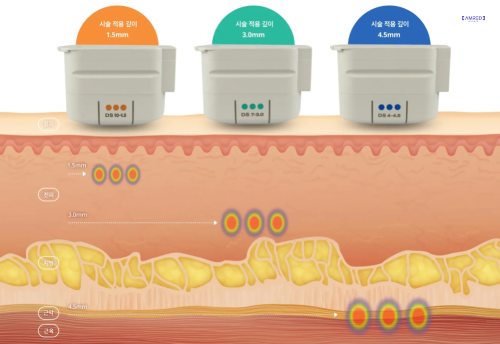
Generally, 1.5mm is used for relatively shallow skin layers, 3.0mm for deeper dermal layers and subcutaneous areas, and 4.5mm for deeper tissues. However, the numbers indicated on the tips cannot be uniformly applied to all individuals when determining the actual target tissue.
This is due to individual differences in skin thickness and anatomical structures across facial areas. Choosing a deeper tip does not necessarily lead to better or more suitable results. The appropriate depth should be reviewed based on the condition of the treatment area and the desired changes.
Ultimately, what matters is not merely using a tip of a specific depth but the process of determining what depth is suitable by considering the tissue condition of the area. The information obtained from Ultherapy ultrasound imaging can also serve as a reference for this decision-making process.
What Are the Differences Between Ultherapy Prime and Traditional Ultherapy?
Ultherapy Prime maintains the treatment principles of traditional Ultherapy while improving the imaging environment, screen composition, and image processing aspects.
The environment in which the information displayed on the screen is examined during the process of visualizing the tissue beneath the skin is also important. Ultherapy Prime enhances this imaging environment, aiding in the examination of tissues and review of treatment areas during the procedure.
However, the mere fact that the imaging environment has improved does not guarantee greater treatment effects for everyone. The actual treatment plan should be determined by considering the individual's skin condition, facial structure, and treatment objectives.
Therefore, when examining Ultherapy Prime, it is essential to understand not only the changes in the equipment but also how the improved imaging environment is utilized during the treatment process.
What Criteria Does AMRED Consider When Formulating an Ultherapy Treatment Plan?
AMRED examines the skin condition, facial structure, and differences in tissue across areas to establish an improvement direction tailored to individual needs during Ultherapy treatment. The necessary treatment scope and depth can vary based on skin thickness, tissue position, and the balance of facial contours and volume.

At this time, AMRED reviews the treatment direction based on a 4D aging resolution that considers the density and depth of the skin, subtle changes, the shape and balance of the face, and the durability over time.
Based on this, the necessity for Ultherapy application and improvement goals are examined, and if appropriate, a treatment plan is established according to the individual's skin condition and treatment objectives. After the procedure, the progress of changes is monitored, and necessary maintenance directions are reviewed.
4D refers to AMRED's proprietary perspective on aging analysis and treatment design, and does not signify an independent medical diagnostic classification or a single treatment name.
Actual treatment plans may vary based on the medical staff's examination and individual conditions.