
Cheongdam Dermatology | What is the difference between XERF and Thermage, both of which are high-frequency lifting?
2026-11-05
Contents
Hello. This is AMRED Clinic.
"Both XERF and Thermage FLX are high-frequency lifting, but what are the differences?"
Both procedures utilize high-frequency energy, but there are differences in how the energy is delivered, the depth of skin considered, and the pain experienced during the procedure. Today, we will compare the characteristics of XERF and Thermage item by item to see what sets them apart.
Are XERF and Thermage the same high-frequency lifting?
XERF and Thermage FLX are both high-frequency (RF) energy devices that deliver energy to the skin tissue to generate heat, thereby inducing improvements in skin elasticity.
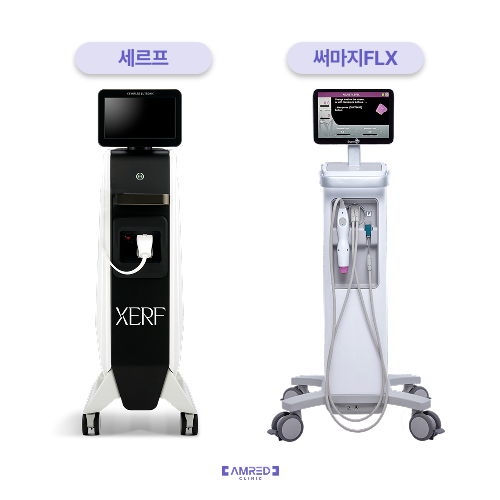
When high-frequency energy is delivered to the tissue, thermal stimulation occurs, which can affect the contraction and remodeling of collagen. Both devices share this principle.
However, just because they use the same high frequency does not mean that the technology and methods of energy delivery are the same. Differences arise in the frequency used, the depth of energy penetration, the shape of the tips, and the cooling methods.
Therefore, it is helpful to understand that XERF and Thermage are devices that utilize the common principle of high frequency through different technical methods.
How do the energy delivery methods of XERF and Thermage differ?
To understand the differences between the two devices, it is necessary to look at the operating frequency, energy delivery depth, and tip area.
Comparison Item | Thermage FLX | XERF |
Operating Frequency | 6.78MHz single frequency | 6.78MHz + 2MHz dual frequency |
Energy Delivery Depth | Center of dermis layer | Dermis layer to subcutaneous fat layer (Shallow·Middle·Deep 3-stage adjustment) |
Tip Area | 4cm² | 6cm² |
First, Thermage FLX uses a single frequency of 6.78MHz and delivers high-frequency energy centered on the dermis layer.
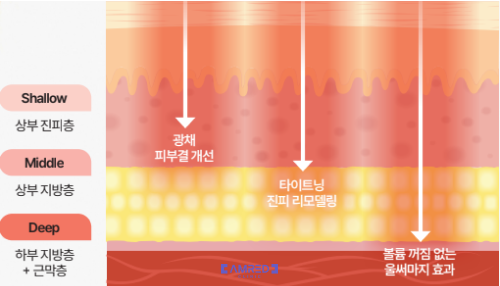
In contrast, XERF utilizes both 6.78MHz and 2MHz dual frequencies. It also allows for energy delivery depth adjustment in three stages: Shallow, Middle, and Deep, considering not only the dermis layer but also the subcutaneous fat layer.
Each stage can be categorized as follows:
Shallow: A stage focused on improving skin texture and radiance centered on the upper dermis layer.
Middle: A stage aimed at tightening and remodeling the dermis by considering up to the upper fat layer.
Deep: A stage that considers the lower fat layer and fascia layer.
There is also a difference in tip area. Thermage FLX has a tip area of 4cm², while XERF has a wider tip area of 6cm². However, the tip area alone cannot determine the effectiveness or duration of the procedure, and actual treatments must consider energy settings and skin conditions as well.
Thus, while both devices utilize high frequency, they have distinct characteristics in terms of frequency composition, energy delivery range, and methods.
Is there a difference in pain and duration of effects between XERF and Thermage?
When choosing a lifting device, one of the aspects people are curious about, as much as the technical differences, is the pain experienced during the procedure and how long the effects last.
First, in terms of pain, Thermage has a cooling function that protects the skin surface during the procedure, but the delivery of high-frequency energy can cause heat or sharp pain.
On the other hand, XERF is designed to apply a cooling system to help reduce the heat sensation and pain burden on the skin surface.
While XERF may feel relatively less painful during the procedure, the actual level of pain can vary depending on individual sensitivity, the treatment area, and energy settings. The need for anesthesia should also be determined based on individual conditions and treatment plans.
Regarding effects, the two devices have different characteristics.
Thermage is characterized by having been used in clinical settings for a long time, accumulating over 20 years of long-term clinical data. This does not mean that the effects of the treatment last for 20 years, but rather that clinical experience and data have been accumulated over a long period.
XERF has the characteristic of allowing for a relatively quick sensation of tightening immediately after the procedure. However, it is necessary to distinguish between the immediate tightening felt right after the procedure and long-term improvements in skin elasticity.
The duration of effects for both devices can be considered to be approximately 6 to 12 months. However, the actual duration and perceived changes can vary depending on individual skin conditions, aging patterns, and lifestyle habits.
Therefore, rather than choosing a device based on just one factor such as pain, immediate sensation, or duration, it is important to consider the characteristics of each device along with the current skin condition and expected improvement direction.
How does AMRED plan for XERF and Thermage?
At AMRED, we prioritize examining the current state of the skin and tissue, the areas showing loss of elasticity, and the overall balance of the face before deciding on a lifting device.

To do this, we review the treatment direction based on a 4D aging resolution that examines the density and volume of the skin and tissue (DENSITY), detailed aging changes (DETAIL), overall facial balance (DESIGN), and changes and durability over time (DURABILITY).
For example, the considerations may differ between cases where fine lines or loss of elasticity are prominent on the skin surface and cases where deeper tissue changes affect facial contours. It is essential to plan the appropriate energy delivery method and management scope by examining the skin condition, areas of aging, and previous treatment history.
It cannot be said that one device is more suitable for everyone among XERF and Thermage. Understanding the technical characteristics of both devices and selecting based on the current skin condition and improvement goals is crucial.
AMRED plans the suitability and treatment direction of XERF and Thermage by considering the overall balance of the face and individual skin conditions based on the 4D aging resolution.
4D is a proprietary aging analysis and treatment design perspective defined by AMRED and does not refer to an independent medical diagnostic classification or a single treatment name.
Actual treatment plans may vary based on the medical staff's assessment and individual conditions.