
Cheongdam Dermatology | How to Naturally Improve Hollow Cheeks and Facial Volume?
2026-11-18
Contents
Why Do Cheeks Appear Hollow?
Hollow cheeks are the area that forms the contour of the face on the sides below the cheekbones, affecting the three-dimensionality and overall impression of the face. When the volume in this area decreases, shadows can form under the cheekbones, making the sides of the face appear flat.
Several factors contribute to hollow cheeks. As we age, the amount and position of facial fat change, and the reduction of collagen and elastin in the skin can weaken the support for the skin and surrounding tissues.
Congenital facial structure, the shape of the cheekbones, original fat distribution, and weight changes also affect the volume of the cheeks. Therefore, when considering treatment, it is essential to examine not only the hollow areas but also the overall face shape and skin condition.
How Does Hollow Cheeks Differ Based on Shape and Range?
Hollow cheeks can be divided into forms where specific areas below the cheekbones are narrow and deeply recessed, and forms where the volume is reduced over a wide range from the temples to the cheeks.
A narrow and deeply hollowed form is characterized by a sunken area just below the cheekbones. In this case, it is essential to consider the depth of the hollow area and the degree of cheekbone protrusion.
On the other hand, widespread volume reduction appears as a generally flat look from the temples to the cheeks below the cheekbones. This is closer to a reduction in the three-dimensionality of the entire side of the face rather than a specific point.
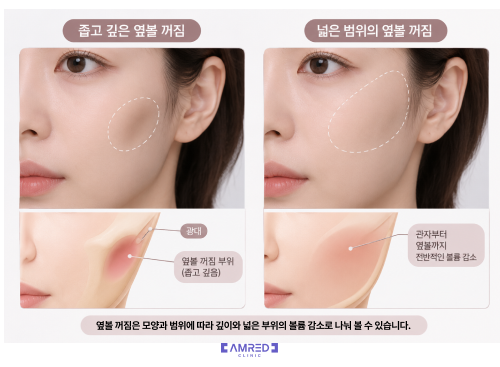
In reality, both forms may appear together, or the degree of hollowness may differ from side to side. Therefore, when planning Sculptra cheek treatments, it is necessary to distinguish the shape and range of hollowness.
What Changes Does Sculptra Bring to Hollow Cheeks?
Sculptra is a collagen-stimulating treatment using PLLA (Poly-L-Lactic Acid). The PLLA microparticles injected into the skin trigger a reaction in the surrounding tissues, inducing collagen production within the skin. The newly formed collagen supports the skin, and over time, changes in volume and elasticity can be expected.
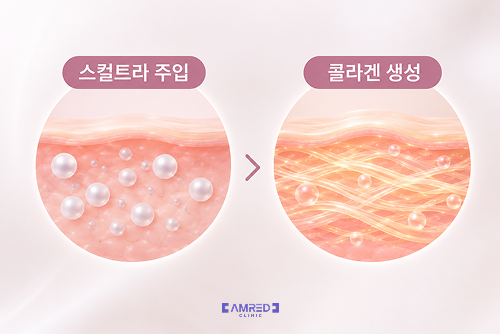
There is a difference in the mechanism of action compared to fillers. While fillers fill the space with the injected substance to create a relatively immediate volume change, Sculptra aims to induce gradual changes through collagen production.
Therefore, it is challenging to assess the final changes based solely on the appearance immediately after the treatment. It is essential to distinguish between the temporary volume changes due to the treatment and the changes that occur later due to collagen production.
When applying it to the cheeks, the depth and range of hollowness, as well as the skin condition, should be considered when planning the treatment. There may be individual differences in the process of change.
Why is it Important to Consider Surrounding Areas When Examining Hollow Cheeks?
The cheeks connect to the temples and cheekbones above, the front cheeks in front, and the deep cheeks and jawline below. Therefore, the shape and volume of the surrounding areas can alter the overall contour of the face.
For example, if the area below the cheekbones is deeply hollow, the degree of cheekbone protrusion can make the shadow more pronounced. Conversely, if there is a wide reduction in volume from the temples to the cheeks, it may be difficult to fully understand the changes in the side of the face by examining just one point.
Even with the same hollow cheeks, the appearance can differ based on the existing face shape. It is essential to consider the height and overall balance with surrounding areas rather than just compensating for the hollow areas.
How Does AMRED Approach Sculptra for Hollow Cheeks?
At AMRED, when planning Sculptra cheek treatments, we examine the location and depth of the hollow areas along with the overall volume distribution of the face.
We assess the degree of cheekbone protrusion from the front and side views, the volume of the temples and front cheeks, and the extent of hollowness in the cheeks, while also considering skin thickness and elasticity. Based on this, we review the areas and range for Sculptra application and the injection plan.

AMRED's 4D aging resolution does not examine facial changes based on a single criterion but considers the density and elasticity of skin tissue (DENSITY), detailed changes such as fine lines and skin texture (DETAIL), overall facial balance (DESIGN), and changes and durability after treatment (DURABILITY). Based on this perspective, we plan the treatment direction that suits the current skin condition and facial contours.
Sculptra cheek treatments cannot be approached merely by adding volume to the hollow areas. To create a treatment plan that harmonizes with the entire face, it is necessary to consider the shape of the cheeks and the balance with surrounding areas.
4D is a proprietary aging analysis and treatment design perspective defined by AMRED and does not refer to an independent medical diagnostic classification or a single treatment name.
Actual treatment plans may vary based on the medical staff's examination and individual conditions.